


The concept of “Altered Carbon” is not merely science fiction born from Richard Morgan’s novels or the popular Netflix series; it is a profound philosophical and technical proposition. It raises deep questions about the future of humanity, immortality, and the relationship between consciousness and the body through “technical cloning.”
Table Of Content
- 1. What is Altered Carbon? (The Stack)
- 2. Cloning in the World of Altered Carbon
- 3. Ethical Dilemmas and Challenges
- 4. Is This Scientifically Possible?
- Mind Uploading: Between Neural Mapping and Quantum Physics
- 1. The Connectome Project
- 2. Whole Brain Emulation (WBE)
- 3. Biophysics and Digital Complexity
- 4. The Three Great Hurdles
- Are We Close?
- Conclusion
1. What is Altered Carbon? (The Stack)
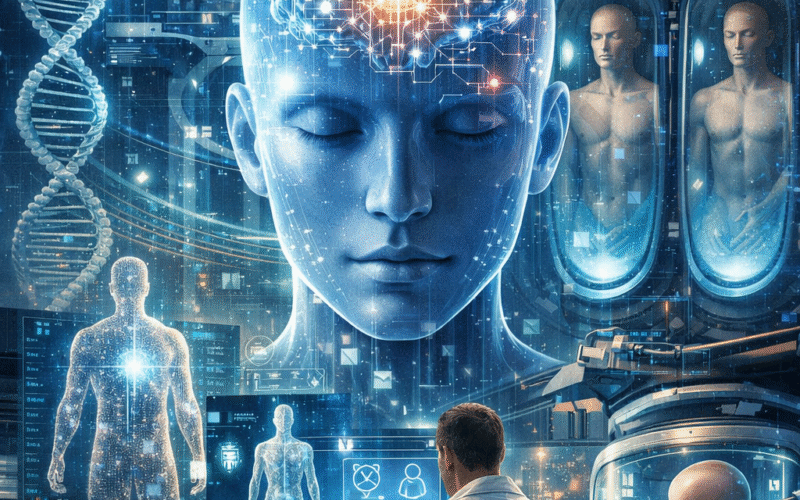
The core idea in this universe relies on the premise that a human being is not their body, but their “data.” This is achieved through a device known as the “Cortical Stack.”
-
The Technology: A small, disk-shaped device implanted into the cervical vertebrae at the base of the skull.
-
The Function: This device records and uploads a person’s consciousness, memories, and personality in a digital format.
-
The Result: The physical body becomes a mere biological vessel called a “Sleeve,” which can be changed or replaced like clothing.
2. Cloning in the World of Altered Carbon
In our current reality, cloning means creating a genetically identical copy of an organism. In the concept of “Altered Carbon,” cloning takes on much more complex dimensions:
-
Sleeve Cloning: The wealthy (known as “Meths”) genetically clone their original bodies and grow them in laboratory tanks. When their current body ages, they transfer their digital consciousness from the Stack into the young version of themselves, ensuring biological immortality.
-
DHF Backup (Digital Human Freight): Beyond physical cloning, consciousness is periodically backed up to satellites. If a person’s “Stack” is destroyed—which is considered “Real Death”—the latest backup can be downloaded into a new cloned sleeve.
3. Ethical Dilemmas and Challenges
While the idea of immortality through Altered Carbon is captivating, it raises thorny issues:
| Issue | Impact |
| Class Divide | Immortality becomes a monopoly for the rich, while the poor die because they cannot afford new “Sleeves.” |
| Identity | If consciousness is cloned into two bodies simultaneously (Double Sleeving), which one is the “true” individual? |
| Human Value | The body becomes a commercial commodity, reducing the sanctity of human life. |
4. Is This Scientifically Possible?
From a realistic perspective in 2026, we are still far from “Altered Carbon” for several technical reasons:
-
Brain Complexity: We have yet to map the full Connectome (the map of neural connections) that constitutes consciousness.
-
Data Storage: The volume of data required to store a single human consciousness exceeds current storage capacities by massive margins.
-
The Transfer: The process of “Mind Uploading” requires a Neural-Computer Interface that is still in its infancy (such as Neuralink experiments).
Mind Uploading: Between Neural Mapping and Quantum Physics
Moving from science fiction to the laboratories of physics and neuroscience, the idea of “Mind Uploading” relies on a philosophical and scientific hypothesis called “Functionalism”—the belief that consciousness is not a magical substance, but rather an “information processing pattern” resulting from the interaction of neurons.
1. The Connectome Project
To upload consciousness, we first need a “road map” of the brain.
-
What is it? It is a comprehensive diagram of all neural connections in the human brain.
-
The Challenge: The human brain contains approximately 86 billion neurons, each connecting to thousands of others, creating a network of trillions of synapses.
-
Current Status: We have successfully mapped the entire connectome of a small roundworm (C. elegans) with only 302 neurons. We are now working on the fruit fly, but the human brain remains technologically out of reach for now.
2. Whole Brain Emulation (WBE)
-
Destructive Scanning: The brain is frozen and sliced into ultra-thin sections (micrometers), then each slice is imaged with an electron microscope to reconstruct the model digitally (as pursued by companies like Nectome).
-
Non-Destructive Scanning: Using “Nanobots” that enter the brain via the bloodstream to monitor the activity of every neuron in real-time and transmit that data externally.
3. Biophysics and Digital Complexity
A major dilemma arises here: Is it enough to transfer the “map,” or do we need to transfer the “physical state”?
-
Mathematical Modeling: If we view the brain as a computational system, it operates with an estimated processing power of $10^{16}$ operations per second.
-
The “Quantum Brain” Hypothesis: Physicist Roger Penrose argues that consciousness cannot be simulated on a classical computer (0s and 1s) because it depends on quantum mechanical effects within microtubules inside neurons. If true, we would need massive Quantum Computers to transfer consciousness.
4. The Three Great Hurdles
| Hurdle | Description |
| Storage | The data capacity of a human brain is estimated at 2.5 Petabytes (equivalent to 3 million hours of HD video). |
| Dynamism | The brain is not static; it is in a state of constant “Neuroplasticity.” Uploading must capture the flow of signals, not just their locations. |
| The Philosophical Paradox | The “Copy Problem”: If you upload your consciousness to a program, are you that program? Or did you die, and the program is just a simulation that thinks it is you? |
Are We Close?
Ray Kurzweil (Google’s Director of Engineering and a prominent tech-optimist) predicts that we will be able to upload human consciousness by 2045. However, most neuroscientists believe this timeline is overly optimistic and that we may need centuries to achieve it.
Conclusion
“Altered Carbon” represents the pinnacle of human dreams to conquer death through technology.



No Comment! Be the first one.