



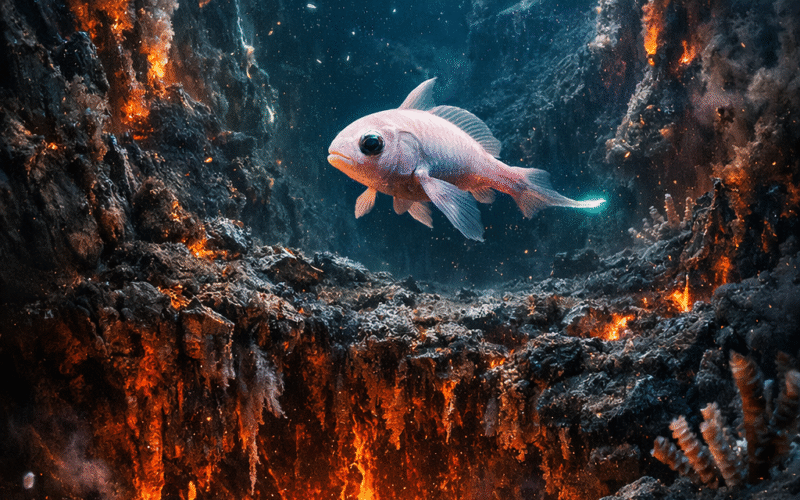
The Snailfish: A Biological Miracle Surviving the “Abyss of the Impossible”
While human technology often stands helpless against the raw power of nature—as seen in the tragic implosion of the “Titan” submersible at 3,800 meters—nature reveals its most resilient masterpiece. In the crushing darkness where steel crumples like paper, the Snailfish lives in total serenity. This creature recently shattered records, becoming the deepest fish ever filmed in human history.
Table Of Content
- A Historic Milestone in the Izu-Ogasawara Trench
- The Mystery of Survival: Why Did “Titan” Fail While the Snailfish Thrives?
- The Secrets of Biological Adaptation
- Magical Chemistry: The TMAO Shield and Cellular Fluidity
- A Genetic Revolution: Insights from Nature Communications
- 1. The “De-ossification” Mutation (bglap gene)
- 2. Vision Loss vs. Vibrational Sight
- 3. An Army of “Molecular Chaperones”
- Japan vs. Mariana: The Battle of the Trenches
- Conclusion: The Final Frontier of Vertebrate Life
A Historic Milestone in the Izu-Ogasawara Trench
In a groundbreaking collaboration between the University of Western Australia (UWA) and the Tokyo University of Marine Science and Technology, cameras captured a stunning moment in the Izu-Ogasawara Trench, south of Japan. At a staggering depth of 8,336 meters—within the “Hadal Zone,” named after the Greek god of the underworld—a species of Pseudoliparis was filmed swimming freely. This discovery wasn’t just a record; it was a scientific challenge to our understanding of the limits of life.
The Mystery of Survival: Why Did “Titan” Fail While the Snailfish Thrives?
The paradox lies in physics. The Titan submersible was constructed from aerospace-grade titanium and carbon fiber, yet it succumbed to pressure at less than half the depth this fish calls home. At 8.3 km deep, the hydrostatic pressure is approximately 800 times that of the surface. To visualize this, imagine a massive elephant balancing its entire weight on your pinky toe.
The Secrets of Biological Adaptation:
-
The Absence of Gas: The primary secret is the lack of “voids.” Unlike surface fish that use swim bladders for buoyancy, the Snailfish has discarded them entirely. At these depths, any gas-filled cavity would instantly become an imploding bomb.
-
Flexible Architecture: Instead of rigid, calcified bones that would shatter under such force, the Snailfish evolved an entirely cartilaginous skeleton. This structure acts as a “shock absorber,” allowing the body to compress with the water pressure rather than resisting it.
-
Gelatinous Skin: Lacking scales, the fish is covered in a thick, translucent jelly-like layer. This helps the fish remain buoyant and evenly distributes external pressure across its entire surface.
Magical Chemistry: The TMAO Shield and Cellular Fluidity
Survival isn’t just about bones; it reaches the molecular level. High pressure tends to “crush” proteins, causing them to lose their functional shape. This is where TMAO (Trimethylamine N-oxide) steps in.
-
The Osmolyte Guard: This chemical acts as a microscopic shield, surrounding proteins and preventing water molecules from crushing them. This ensures vital biological processes remain stable.
-
Membrane Fluidity: High pressure normally causes fats (lipids) to solidify, killing the cell. However, the Snailfish’s genome has evolved to produce specific unsaturated fatty acids that keep the cell membranes “fluid,” ensuring nerves can fire and muscles can move smoothly despite the crushing weight.
A Genetic Revolution: Insights from Nature Communications
A landmark study published in Nature Communications sent shockwaves through the scientific community after analyzing the genome of the Mariana Snailfish (Pseudoliparis swirei). The study revealed unique genetic mutations:
1. The “De-ossification” Mutation (bglap gene)
Scientists discovered that the gene responsible for turning cartilage into hard bone (bglap) has undergone a “stop mutation.” This isn’t a defect; it is a brilliant evolutionary move that allows the fish to maintain a “rubbery” skeleton throughout its life.
2. Vision Loss vs. Vibrational Sight
In 100% darkness, eyes are an energetic burden. Consequently, these fish have lost the genes for color vision (cones). Instead, they have amplified genes related to the Lateral Line System—a biological radar that allows them to “see” water vibrations and the movement of prey through tactile sensors along their bodies.
3. An Army of “Molecular Chaperones”
The fish possesses extra copies of “Chaperone” genes. These act as quality-control monitors within the cell; if a protein begins to deform due to pressure, these chaperones immediately refold and repair it, keeping the fish’s metabolism running perfectly.
Japan vs. Mariana: The Battle of the Trenches
Although the Mariana Trench is deeper (11 km), the deepest fish was found in the Izu-Ogasawara Trench (8,336 m). Scientists believe the secret is temperature. The water in the Japanese trench is roughly 0.1°C warmer. This tiny fraction allows the fish to withstand the pressure more effectively, as extreme cold compounds the destructive effects of pressure on cellular chemistry.
Conclusion: The Final Frontier of Vertebrate Life
The Snailfish is the “ultimate traveler” at the bottom of the world. According to chemical calculations, 8,400 meters represents the absolute biological limit for fish. Beyond this point, the amount of TMAO required to stabilize the body would become toxic to the cells, making life impossible for vertebrates.
The Snailfish is a message from nature: sometimes, “softness” and flexibility are stronger than titanium and steel. It reminds us that adaptation isn’t always about resisting force—it’s about harmonizing with it.







No Comment! Be the first one.