



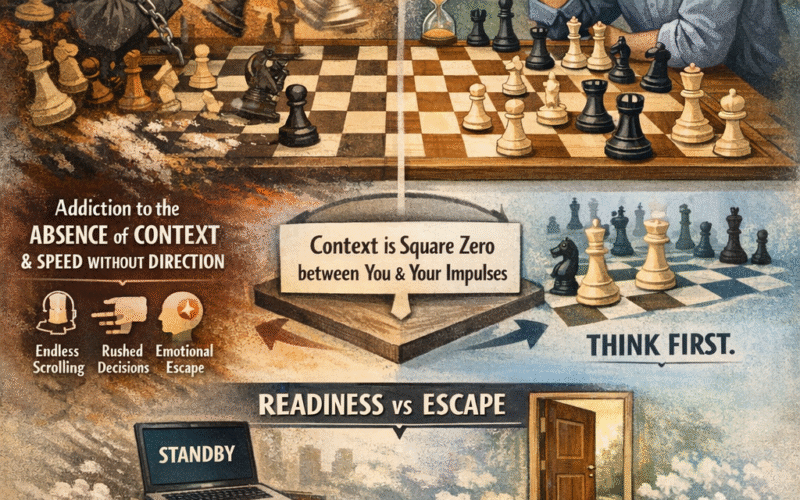
Social Media Addiction: Is It Really an Addiction to the Absence of Context?
Social media addiction is often described as an uncontrollable urge to scroll endlessly through digital platforms. However, what many people call social media addiction may actually be something deeper — an addiction to the absence of context. When our actions lack meaning or direction, digital platforms easily become substitutes for purpose.
Table Of Content
Social Media Addiction and the Psychology of Context
Imagine you are playing chess. Every move requires reflection: where should you begin, and how will your opponent respond? The player who understands their strategy gains more control over the board. Similarly, when life decisions lack context, people often replace reflection with speed.
As explored in our article about
how the body reflects emotional awareness, human behavior often reveals deeper psychological patterns beneath everyday actions.
The Addiction to Speed in Decision Making
Another dimension of social media addiction is the growing habit of making rapid decisions without considering timing. When individuals pause to create context, a familiar inner voice may appear:
You spent your whole life gathering weapons. When will you finally fight?
This pressure pushes people toward immediate action rather than thoughtful reflection. Context acts like the starting square between emotion and behavior. Without it, emotional impulses easily take control.
Emotional Suppression and Digital Escape
When context disappears, emotional suppression often follows in subtle forms: frustration, anger, fear of confrontation, or the habit of ignoring intuition. These emotions do not vanish — they simply hide beneath constant activity.
According to research shared by
the American Psychological Association, digital behavior patterns often reflect underlying emotional needs rather than simple entertainment.
The Difference Between Human Behavior and Machines
Consider electronic devices for a moment. A laptop never stops working because it feels depressed or overwhelmed. Machines are built around a single principle: standby readiness.
Humans operate differently. Instead of readiness, we sometimes choose escape. And this escape forms the psychological core of what we label social media addiction.
Why Context Reduces the Power of Social Media Addiction
When people avoid defining purpose or meaning, they search for quick substitutes: endless scrolling, rushed decisions, and constant stimulation. Yet when clear context exists, tasks become easier and emotional reactions become more manageable.
Context does not eliminate problems. Instead, it reduces their intensity and helps individuals respond more consciously.
Understanding the Game Before Moving the Piece
In the end, the real issue may not lie in social media platforms themselves. The problem often lies in how individuals use them to escape internal emptiness.
When someone understands why they are doing something, technology becomes a tool rather than a refuge. And when clear context guides our decisions, we realize that controlling the board was never about moving faster.
It was always about understanding the game first. ♟️







No Comment! Be the first one.