


A “Zombie” Reality That Surpasses Hollywood’s Imagination
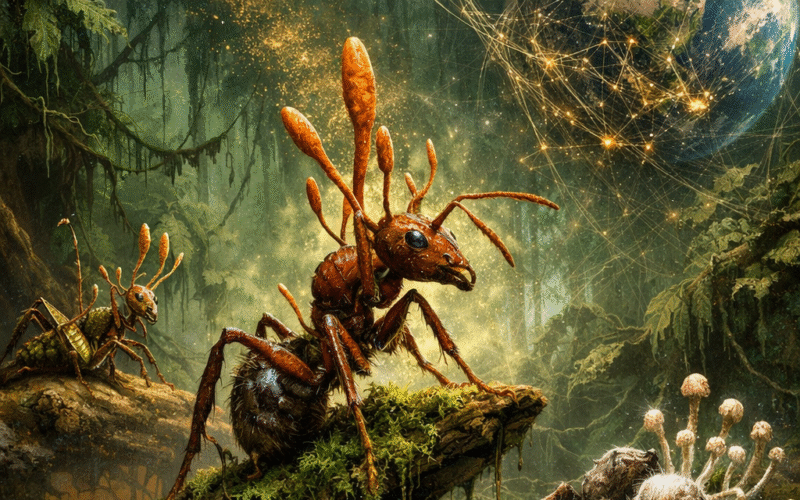
The concept of “Zombies” has long haunted human imagination through Hollywood movies, but in the depths of the forests, a real-life horror story unfolds, driven by a creature with no eyes and no brain. The “Zombie” phenomenon is not merely a cinematic trope; it is a terrifying reality that insects face daily. This fungus, specifically Cordyceps, does not kill its victim immediately. Instead, it employs a complex mental and physical control strategy that outclasses even the most advanced human laboratories.
Table Of Content
- A “Zombie” Reality That Surpasses Hollywood’s Imagination
- First: The Infection Mechanism.. A Silent Invasion and the Theft of Will
- 1. Hidden Control
- 2. The “Death Grip” and the Tragic End
- Second: Fungi as the Planet’s Nervous System
- 1. The “Wood Wide Web”
- 2. Masters of Mind Control
- Third: Fungi as Technological and Environmental Solutions for Our Future
- A Philosophical Vision of Intelligence
- Conclusion: A Call for Human Humility
First: The Infection Mechanism.. A Silent Invasion and the Theft of Will
The journey begins with microscopic, invisible “spores” circulating in the air. Once these spores land on an insect’s body (such as an ant or a beetle), they penetrate its tough exoskeleton and seep inside.
1. Hidden Control
At this stage, the process of domination begins. The fungus does not destroy vital organs; rather, it grows slowly, sending out delicate fungal threads (mycelium) that wrap around muscles and the nervous system, turning them into “tools of obedience.” During this phase, the insect loses its will entirely, even though it remains alive and breathing.
2. The “Death Grip” and the Tragic End
The fungus forces the insect to abandon its nest and follow an unnatural path. It leads the victim to a high vantage point (a branch or a leaf) at a specific angle that ensures the later dispersal of spores. Upon reaching the desired spot, the fungus issues its final command—known as the “Death Grip.” The insect sinks its mandibles into the plant with unnatural force, anchoring itself forever.
After fixation, the fungus begins consuming the insect from the inside out, devouring its muscles and vital tissues, leaving behind nothing but a hollow outer shell—a macabre “puppet.” At the climactic moment, a fungal stalk erupts from the insect’s head, piercing its skull to burst and release thousands of new spores into the air, beginning the cycle of horror anew with fresh victims.
Second: Fungi as the Planet’s Nervous System
In his groundbreaking book “Entangled Life,” scientist Merlin Sheldrake debunks the traditional idea that limits fungi to the “mushrooms” we see above ground. He explains that what we see is merely the “fruit,” while the true body of the fungus is the Mycelium—a vast network of microscopic threads extending underground for thousands of miles.
1. The “Wood Wide Web”
Sheldrake describes how fungi connect trees and plants through a “natural internet” that allows them to exchange food, chemicals, and even warnings about pests. Without these fungi, forests would collapse entirely; they manage the forest’s economy, distributing resources between the strong and the weak.
2. Masters of Mind Control
Sheldrake poses a fundamental question: Who is controlling whom? This opens the door to reflecting on how much microbes and fungi might also influence human behavior.
Third: Fungi as Technological and Environmental Solutions for Our Future
The role of fungi extends beyond control or connectivity; they may be a lifeline for our future:
-
Mycoremediation: The ability of certain species to break down plastics and toxic oil waste.
-
Bio-fabrication: Using fungi to create sustainable building materials as alternatives to bricks or eco-friendly “mycelium leather.”
A Philosophical Vision of Intelligence
Sheldrake challenges the human-centric concept of intelligence. Fungi make complex decisions (such as choosing the shortest path to food) without a central brain, forcing us to redefine the meaning of consciousness and “smart” solutions in nature.
Conclusion: A Call for Human Humility
“Entangled Life” and the story of the Cordyceps fungus serve as a call for humility. They prove that we are not separate entities living “on” the Earth, but rather part of a “tangled” fabric led by fungi for millions of years. The truth in the natural world is not only stranger than fiction; it is far more interconnected and intelligent than we can fathom.







No Comment! Be the first one.