Do you remember the T-1000 robot from Terminator 2, which could change its shape and pass through metal bars? What was once pure Hollywood science fiction is now becoming reality inside scientific laboratories. A team of scientists has successfully developed liquid metal robots capable of splitting, self-healing, and reshaping themselves to move through complex environments.
What Is a Magnetic Liquid Metal Robot?
This technology is based on combining microscopic magnetic particles (such as neodymium or iron) with liquid metals that remain fluid at room temperature—most notably gallium.
How Does It Work?
Remote Control: The robot is manipulated using external magnetic fields, allowing it to move without internal batteries or wires.
State Transformation: By applying specific frequencies, the metal can switch from a solid state (to overcome obstacles) to a liquid state (to slip through tight spaces), and then return to solidity again.
Key Applications and Future Uses
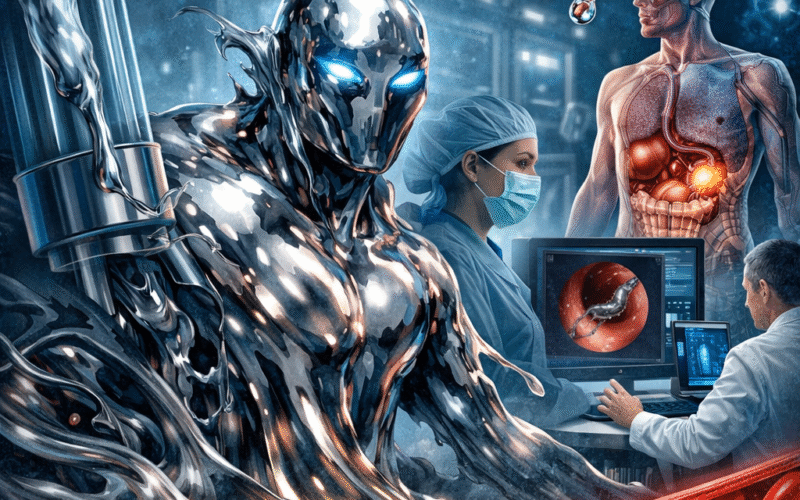
Medicine and Precision Surgery: These robots can enter the human body through veins to deliver drugs directly to cancer tumors or remove foreign objects from the stomach.
Electronics Repair: Since liquid metal is highly conductive, it can act as a “smart solder” to repair circuits in hard-to-reach areas.
Micro-Logistics Operations: Transporting materials through narrow pipes or hazardous chemical environments.
Challenges Facing Scientists
Despite their promise, several obstacles remain:
Toxicity: Ensuring that materials like gallium are completely safe for long-term use inside the human body.
Precision: Developing more advanced magnetic control systems for accurate navigation.
What Has the CUHK Team Achieved?
Professor Li Zhang and his team have developed a viscous material based on a non-Newtonian system, combining properties of both liquids and solids.
Key breakthroughs include:
High Stretchability: The robot can extend several times its original length, enabling it to pass through extremely narrow channels such as blood vessels or the small intestine.
Precise Magnetic Control: External magnetic fields can shape the material into forms like “O” or “C,” allowing it to grasp and surround foreign objects.
Self-Healing Ability: If the robot splits into parts, it can rejoin and function as a single unit once the pieces come back together.
Latest Developments According to ScienceDaily
Recent reports indicate a shift from simple movement to biological functionality:
Encapsulation of Toxic Materials: Magnetic particles are now coated with silica layers to make them biocompatible and safe for use inside the human body.
Solid-to-Liquid Transformation: New robots made of gallium mixed with magnetic particles can switch between solid (for carrying loads) and liquid (for escaping tight spaces) using magnetically induced heating.
Targeted Drug Delivery: Advanced versions can carry drugs and release them only at specific locations, such as cancer cells, triggered by magnetic or thermal signals.
What’s Next?
Scientists are working to move from laboratory testing to clinical trials. The next step involves integrating these robots with medical imaging systems (like X-rays or ultrasound) so doctors can track and control them in real time with extreme precision.
In Short
We are entering the era of “soft robotics”—machines that resemble living organisms in their flexibility and adaptability. This innovation is set to revolutionize medicine and precision industries.
They rely on combining microscopic magnetic particles with liquid metals like gallium, controlled remotely using magnetic fields.
Key Developments:
The Chinese University of Hong Kong (CUHK) developed a “slime robot” capable of stretching through extremely narrow channels and wrapping around foreign objects.
ScienceDaily reports breakthroughs in state transformation and biocompatibility through material coating.
Section Two (New): Bio-Hybrid Robots – Merging Living Tissue with Machines
While liquid magnetic robots rely entirely on synthetic materials, scientists are now exploring a more ambitious path: bio-hybrid robotics. This approach doesn’t just imitate nature—it integrates it.
What Is a Bio-Hybrid Robot?
A system that combines engineered components (like microstructures) with living tissues or cells (such as muscle or nerve cells).
How Do They Work? Why Use Living Tissue?
Biological Muscles as Motors: Instead of mechanical engines, scientists use muscle cells (like cardiac or skeletal muscle). When stimulated electrically or optically, these cells contract and relax, producing movement.
Unique Advantages of Living Materials:
Energy Efficiency: Muscles operate using simple nutrients like glucose.
Self-Healing: Living tissues can repair themselves if damaged.
High Sensitivity: Cells act as natural sensors, responding precisely to chemical, thermal, and light stimuli.
Integration of Both Technologies: A Promising Future
Future research aims to merge both fields:
Biologically Guided Liquid Robots: Imagine a magnetic liquid metal robot coated with living cells, combining muscle-like efficiency with precise magnetic control.
Smart, Responsive Systems: Using nerve cells as a simple “brain,” enabling robots to make autonomous decisions while still allowing external magnetic control.
Conclusion: Redefining Machines and Medicine
We are no longer just building better machines—we are redefining what a machine is. Integrating living tissues with magnetic liquid systems paves the way for microscopic “surgeons” capable of performing highly precise, minimally invasive procedures. This breakthrough could transform the treatment of complex diseases and revolutionize modern medicine.










No Comment! Be the first one.