



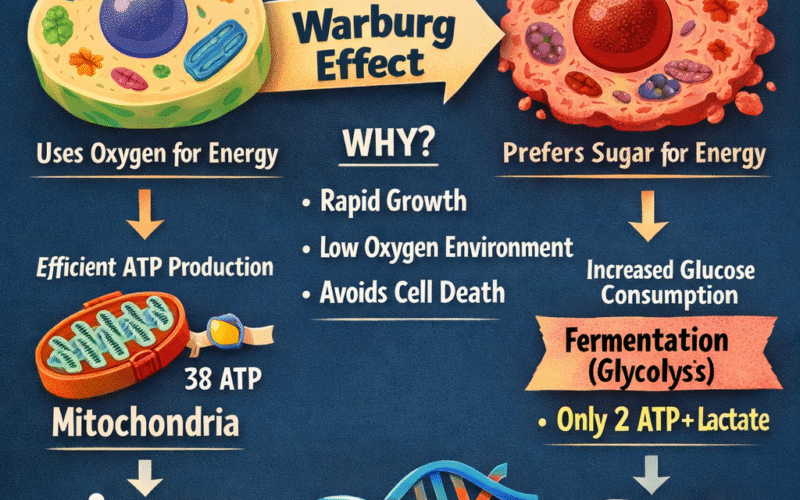
The Warburg Effect is one of the most important concepts in modern cancer biology. It describes how cancer cells produce energy in a way that is fundamentally different from normal healthy cells.
Table Of Content
- 1. Glycolysis
- How Glycolysis Works
- Results of Glycolysis
- 2. Cellular Respiration in the Mitochondria
- Stages of Cellular Respiration
- Stage 1: Glycolysis
- Stage 2: The Krebs Cycle
- Stage 3: Electron Transport Chain
- Final Energy Yield
- 1. Speed Is More Important Than Efficiency
- 2. Building Materials for New Cells
- 3. Altering the Tumor Microenvironment
- How a PET Scan Works
This phenomenon was first discovered in the 1920s by the German biochemist and Nobel Prize winner
Otto Heinrich Warburg, who was studying how cells generate energy through metabolic processes.
During his research, Warburg observed something unexpected:
cancer cells tend to produce energy primarily through glycolysis, even when oxygen is available. This behavior is unusual because normal cells prefer a much more efficient energy production pathway when oxygen is present.
In this article, we will explore in detail:
-
How normal cells produce energy
-
What happens metabolically inside cancer cells
-
Why cancer cells rely on glycolysis
-
How this phenomenon is used in modern cancer diagnosis
How Normal Cells Produce Energy
Every cell in the human body requires energy to perform essential functions such as:
-
Cell division
-
Protein synthesis
-
Transport of molecules
-
Maintaining internal balance (homeostasis)
The main energy currency used by cells is a molecule called ATP.
Cells typically generate ATP using two main metabolic pathways.
1. Glycolysis
The first pathway is known as
Glycolysis.
Glycolysis is the initial step in the breakdown of glucose inside the cell.
How Glycolysis Works
-
Glucose enters the cell.
-
The glucose molecule is broken down through a series of enzymatic reactions.
-
A small amount of energy is produced.
Results of Glycolysis
-
Production of 2 ATP molecules
-
Formation of pyruvate
-
Possible conversion of pyruvate into lactic acid
The main advantage of glycolysis is speed, but it is not very efficient in terms of total energy production.
Cells usually rely on glycolysis when oxygen is limited, such as during intense physical exercise.
2. Cellular Respiration in the Mitochondria
When oxygen is available, cells typically switch to a much more efficient energy production system known as
Cellular Respiration.
This process occurs in specialized structures inside the cell called mitochondria.
Stages of Cellular Respiration
Cellular respiration occurs in three main stages:
Stage 1: Glycolysis
The first step occurs in the cytoplasm.
Stage 2: The Krebs Cycle
Also known as the
Citric Acid Cycle.
This cycle extracts additional energy from the products of glycolysis.
Stage 3: Electron Transport Chain
Known as the
Electron Transport Chain.
This stage produces the majority of ATP molecules through oxidative phosphorylation.
Final Energy Yield
From a single glucose molecule, cellular respiration can produce approximately:
36 ATP molecules
This makes cellular respiration far more efficient than glycolysis.
What Happens in Cancer Cells?
This is where the Warburg Effect becomes evident.
Instead of relying primarily on cellular respiration, cancer cells preferentially use glycolysis, even when oxygen is readily available.
This unusual metabolic strategy is known as:
Aerobic Glycolysis
At first glance, this seems inefficient because glycolysis produces far less ATP than mitochondrial respiration. However, researchers have discovered several reasons why this metabolic strategy benefits rapidly growing tumors.
Why Do Cancer Cells Prefer Glycolysis?
Scientists have identified multiple advantages that glycolysis provides to cancer cells.
1. Speed Is More Important Than Efficiency
Cancer cells divide extremely quickly. To sustain rapid growth, they require energy production that is fast, even if it is not highly efficient.
Glycolysis allows cells to generate ATP at a rapid rate, enabling continuous cellular proliferation.
2. Building Materials for New Cells
Cancer cells require more than just energy. They also need raw materials to construct new cellular components, including:
-
DNA and RNA
-
Proteins
-
Lipids
Many intermediate molecules produced during glycolysis can be redirected into biosynthetic pathways that help generate these essential building blocks.
This metabolic flexibility supports rapid tumor growth.
3. Altering the Tumor Microenvironment
Glycolysis results in the production of
Lactic Acid.
Accumulation of lactic acid around the tumor creates an acidic microenvironment that can have several effects:
-
Suppression of immune cell activity
-
Damage to surrounding normal tissues
-
Facilitation of tumor invasion and metastasis
This environment ultimately helps cancer cells survive and spread more effectively.
How the Warburg Effect Is Used in Cancer Diagnosis
One of the most important medical applications of the Warburg Effect is in cancer imaging.
A well-known example is the diagnostic technique called
PET Scan.
How a PET Scan Works
-
A patient is injected with a radioactive form of glucose.
-
Cancer cells absorb glucose much more rapidly than normal cells.
-
The radioactive glucose accumulates in areas of high metabolic activity.
-
Imaging equipment detects these areas, revealing the presence of tumors.
This method allows physicians to detect cancers, evaluate tumor activity, and monitor treatment responses.
Are Mitochondria Damaged in Cancer Cells?
Initially,
Otto Heinrich Warburg believed that cancer was primarily caused by permanent damage to mitochondria.
However, modern research has shown that in many cancers:
Mitochondria remain functional.
Instead, cancer cells undergo metabolic reprogramming, meaning they adjust their energy production pathways to support rapid growth and survival.
In other words, cancer cells do not necessarily lose the ability to perform cellular respiration—they simply rely more heavily on glycolysis.
Can the Warburg Effect Be Targeted for Cancer Treatment?
Because cancer cells depend heavily on glycolysis, researchers are investigating therapies that target this metabolic pathway.
Some strategies include:
-
Inhibiting key glycolytic enzymes
-
Reducing glucose uptake by tumor cells
-
Blocking metabolic pathways that supply building materials for tumor growth
Although many of these approaches are still under investigation, targeting cancer metabolism represents a promising area of modern oncology research.
Common Misconceptions
A popular claim on the internet suggests that “sugar causes cancer.”
This statement is misleading.
The scientific reality is:
-
All cells in the human body use glucose as an energy source.
-
Cancer cells simply consume glucose at a much higher rate.
Therefore, consuming sugar alone does not directly cause cancer.
Conclusion
The Warburg Effect is a key metabolic feature of many cancer cells. It describes how tumors rely heavily on glycolysis for energy production, even when oxygen is available.
This metabolic shift provides several advantages to cancer cells, including:
-
Rapid energy production







No Comment! Be the first one.