



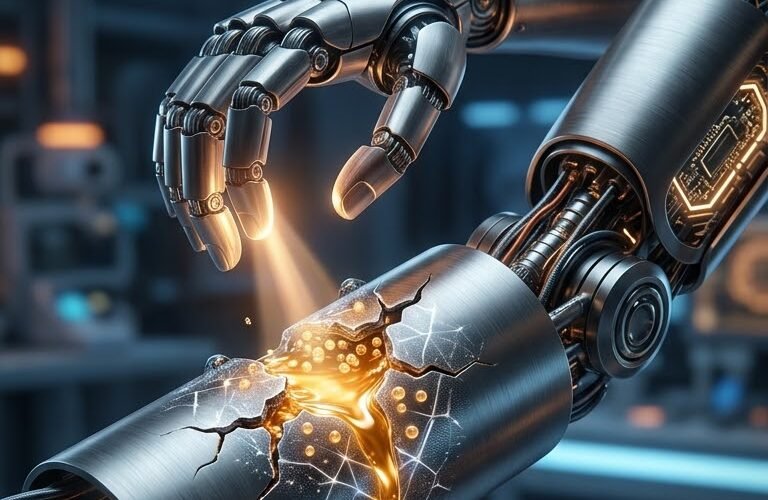
Self-Healing Materials: When Technology Heals Its Own Wounds
Imagine a world where cracks in walls don’t need manual repair, car scratches vanish on their own, and electronic devices fix their broken circuits automatically. This isn’t a scene from a sci-fi movie; it is the reality brought forth by Self-Healing Materials.
Table Of Content
What are Self-Healing Materials?
Self-healing materials are an innovative class of smart materials that possess the artificial ability to repair mechanical damage (such as cracks or fractures) and restore their original functions autonomously, with little to no human intervention. These materials are inspired by living organisms, where skin or bones regenerate themselves after an injury.
How Do They Work? (Healing Mechanisms)
These materials rely on precise engineering strategies, which can be divided into two main types:
1. Extrinsic Systems
These rely on a pre-stored “healing agent” within the material:
-
Microcapsules: Liquid healing agents (like resins) are sequestered into microscopic capsules. When a crack occurs, the capsules rupture, releasing the agent to fill and seal the gap.
-
Vascular Networks: Similar to human blood vessels, these consist of a network of micro-channels that continuously pump healing agents to the damaged area.
2. Intrinsic Systems
These do not require added agents; instead, they rely on the chemical nature of the material itself:
-
Reversible Chemical Bonds: These use dynamic bonds (such as hydrogen bonds or dynamic covalent bonds) that break upon damage and then reform automatically.
-
Thermal Activation: Some materials only require a slight increase in temperature to trigger molecular mobility and close the cracks.
Industry-Changing Applications
The applications of self-healing materials are expanding across vital sectors, including:
-
Aerospace: Developing aircraft wings capable of repairing microscopic cracks during flight, significantly increasing safety levels.
-
Construction: Producing “Bio-concrete” containing bacteria that produce calcite to seal cracks as soon as they appear, extending the lifespan of infrastructure.
-
Electronics: Smartphones with self-healing screens and batteries that fix internal micro-fractures, reducing electronic waste.
-
Automotive: External coatings where scratches disappear simply by exposure to sunlight.
Advantages and Economic Benefits
-
Extended Lifespan: Reducing the need to replace damaged parts.
-
Reduced Maintenance Costs: Saving billions of dollars spent on manual inspections and repairs.
-
Environmental Sustainability: Lowering raw material consumption and reducing industrial waste.
Challenges and the Future
Despite this remarkable progress, challenges remain, such as high production costs and the difficulty of achieving repeatable healing in the same spot multiple times. However, experts predict these materials will become a standard in heavy industries over the next decade.






No Comment! Be the first one.