


Is It Connected to an Ancient Genetic Bottleneck in Human History?
When studying human history from the perspective of population genetics, researchers—including the Austrian monk and scientist Gregor Mendel and the Dutch botanist Hugo de Vries—have discovered that some biological traits that appear simple on the surface, such as blood groups, actually carry a deep evolutionary record extending back millions of years.
Table Of Content
- Is It Connected to an Ancient Genetic Bottleneck in Human History?
- Why Is Blood Type O the Most Common Worldwide?
- What is the result?
- A famous example: Indigenous peoples of the Americas
- Another example: Pacific Island populations
- Example from Europe: The Basque population
- Blood Groups as a Window into Human Evolution
Among these traits, the ABO blood group system stands out as one of the most extensively studied genetic systems in human biology. Its importance does not lie only in its medical relevance for blood transfusions, but also in the fact that it provides a unique window into understanding human evolution, migration, and long-term interactions with diseases and environments.
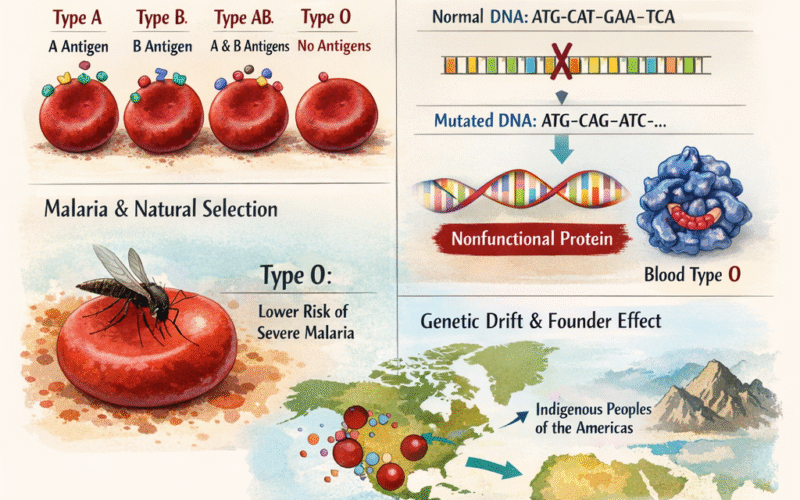
The uneven global distribution of blood groups among populations and continents is therefore not a random phenomenon. Instead, it results from a complex series of evolutionary processes, including:
-
Natural Selection
-
Genetic Drift
-
Founder Effect
In addition to major demographic events such as Population Bottleneck that humans experienced during their evolutionary history.
Why Is Blood Type O the Most Common Worldwide?
Blood type O is the most widespread globally. In some regions—especially in Latin America—its frequency reaches 70–80% of the population.
This remarkable prevalence cannot be explained by a single cause. Rather, it is the result of multiple evolutionary processes acting together over long periods of time.
1️⃣ The Genetic Origin of Blood Type O
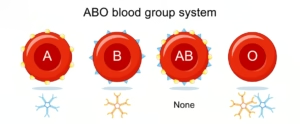
Blood type O is not a completely different gene. Instead, it is a mutated version of the ABO gene.
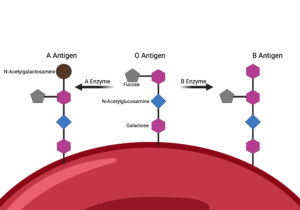
The gene responsible for blood groups produces an enzyme that adds specific sugars to the surface of red blood cells. These sugars form the antigens that determine the blood type recognized by the immune system.
The mechanism works as follows:
-
If the gene produces an enzyme that adds the sugar N-acetylgalactosamine, the blood type becomes A.
-
If it produces an enzyme that adds galactose, the blood type becomes B.
However, what happened in the case of blood type O is quite different.
At some point in evolutionary history, a very small genetic mutation occurred within the ABO gene. This mutation involved the deletion of a single nucleotide base from the DNA.
This type of mutation is called a:
Deletion mutation
Although the deletion is extremely small, it causes a major problem known as a:
Frameshift mutation
DNA inside the cell is read in groups of three bases, called codons. Each codon corresponds to a specific amino acid used to build a protein.
When a single base is deleted, the reading frame shifts. As a result, all subsequent codons change, which leads to the production of a truncated or nonfunctional protein.
What is the result?
The enzyme that should normally add sugars to the surface of red blood cells no longer functions properly.
Therefore, the red blood cells remain in their basic state, without the addition of A or B antigens.
This is why the blood type appears as O.
In simple terms:
The cell originally intended to add a specific antigen, but the mutation disabled the molecular machinery responsible for adding it.
The final outcome:
-
No A antigen
-
No B antigen
Thus, the blood type becomes O.
This particular mutation is well known in genetic studies and is referred to as the O01 allele, which is the most common O variant worldwide.
Molecular studies suggest that this mutation appeared hundreds of thousands of years ago in human ancestors and later spread through populations due to several evolutionary mechanisms.
Over time, the O allele became one of the most widespread alleles in the human species.
2️⃣ Natural Selection and Infectious Diseases
One of the most important reasons behind the spread of blood type O is natural selection related to infectious diseases.
A well-known example is Malaria.
Research has shown that red blood cells of type O exhibit reduced levels of a phenomenon known as rosetting.
Rosetting occurs when malaria-infected cells cluster together with healthy red blood cells. This process contributes to the severity of the disease.
In individuals with blood type O, this clustering is less likely to occur, which reduces the risk of severe malaria complications.
As a result:
People with blood type O have relative protection against severe malaria, which may have increased the survival of individuals carrying this blood type in malaria-endemic regions.
3️⃣ Genetic Drift
Another important factor contributing to the spread of blood type O is genetic drift.
In small populations, certain genes can become common simply by statistical chance, rather than because they provide a strong survival advantage.
For example:
If a small group of early humans happened to have a high proportion of blood type O, and that group expanded over time, the trait could become dominant among their descendants.
A famous example: Indigenous peoples of the Americas
Genetic studies have shown that Indigenous populations of North and South America have extremely high frequencies of blood type O, sometimes reaching 90–100% in certain tribes.
This pattern is believed to result from the Founder Effect, when a small founding population carried mostly O alleles before expanding across the continents.
Another example: Pacific Island populations
Some islands in Polynesia and Micronesia also show high frequencies of blood type O.
The reason is similar to what occurred in the Americas: small founding populations combined with long periods of geographic isolation.
Example from Europe: The Basque population
Among the Basque people in the Pyrenees region of Europe, blood type O is also unusually common.
Researchers believe this pattern may be related to thousands of years of geographic and cultural isolation in the Pyrenees Mountains, which limited genetic mixing with surrounding populations.
4️⃣ Evolutionary Balance
Despite the widespread distribution of blood type O, the other blood types A, B, and AB did not disappear.
The reason lies in a phenomenon known as balanced selection.
Different blood types may provide advantages against different pathogens.
For example:
| Blood Type | Possible Advantage |
|---|---|
| O | Reduced severity of malaria |
| A | Resistance to certain bacterial infections |
| B | Potential resistance to some viral infections |
This evolutionary balance helps maintain multiple blood types within human populations rather than allowing a single type to completely dominate.
Blood Groups as a Window into Human Evolution
Today, the study of blood groups is no longer viewed merely as a medical issue related to blood transfusions.
Instead, it has become an important scientific tool for understanding:
-
Human biological history
-
The complex interaction between genes and the environment
-
The evolutionary arms race between humans and infectious diseases
-
Ancient human migrations across continents
-
Demographic events that reshaped the genetic landscape of humanity
Each blood group therefore carries, within its molecular structure, the imprint of millions of years of evolutionary history.
It reflects—indirectly—the ancient struggles between humans and pathogens, the long migrations that carried small groups of humans into new continents, and the demographic changes that gradually reshaped the genetic map of our species.
For this reason, geneticists today view the ABO blood group system as a powerful model illustrating how a seemingly simple biological trait can encode a complex evolutionary story spanning hundreds of thousands of years.







No Comment! Be the first one.