



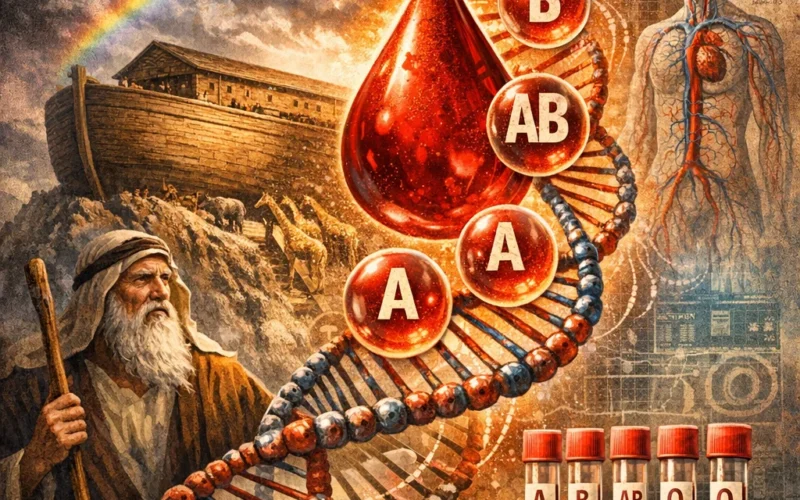
A new theory has sparked widespread debate after attempting to connect the story of Noah’s Ark, described in the Bible, with the eight known human blood types.
Table Of Content
According to the biblical narrative, only eight people survived the Great Flood:
-
His wife
-
His three sons
-
The wives of his three sons
These eight individuals are believed, within the religious tradition, to have become the ancestors of all humans living today.
Some researchers and internet users have pointed out an intriguing coincidence:
The number of survivors (8 people) appears to match the number of main human blood types (8 types).
This numerical similarity quickly spread across social media, where some people interpreted it as evidence of a deeper design.
One viral claim summarized the idea as:
“The Bible is a living blueprint of the human body.”
However, many scientists and critics argue that the connection is likely nothing more than a numerical coincidence.
Human Blood Types
Scientists classify human blood according to two major systems:
-
The ABO blood group system
-
The Rh blood group system
When these two systems are combined, they produce eight primary blood types:
-
A+
-
A−
-
B+
-
B−
-
AB+
-
AB−
-
O+
-
O−
This classification is essential in modern medicine, especially for blood transfusions, organ transplantation, and immunological compatibility.
The Theory Behind the Claim
Supporters of the theory propose a simple explanation.
If humanity restarted after the flood from eight individuals, the mixing of their genes across generations could have produced the blood types seen today.
Some proponents also suggest that:
-
Type O, the most common blood type worldwide,
-
may have originated from one member of Noah’s family and later spread as the human population expanded.
The reasoning behind this idea loosely relates to a concept in genetics known as the Founder effect.
This concept describes a situation where:
A small group of individuals establishes a new population, and their genetic traits become disproportionately common among later generations.
However, applying this idea directly to the story of Noah’s Ark raises significant scientific challenges.
Scientific Criticism of the Theory
Many scientists reject the theory and consider it a numerical coincidence rather than a biological explanation.
Modern genetics indicates that the diversity of human blood types did not arise from a small group of individuals within a short time span.
Instead, blood group diversity developed gradually over long evolutionary timescales.
Evidence suggests that the ABO blood group system is far older than human civilization.
In fact, versions of the ABO system exist in several species of primates and monkeys, dating back more than 20 million years. This strongly indicates that the system evolved long before modern humans appeared.
What Genetics Actually Says About Blood Types
The diversity of blood types is explained by processes studied in Genetics and **Population genetics.
Scientists generally attribute blood type diversity to several evolutionary mechanisms:
-
Genetic mutations that alter specific genes
-
Natural selection, especially through interactions with infectious diseases
-
Population migration and mixing across continents
-
Genetic drift in small populations over long periods
These processes operate over thousands to millions of years, not just a few generations.
Contributions of Major Scientists to Modern Genetics
Modern understanding of heredity and genetic diversity comes from centuries of scientific research.
Several key scientists played major roles in building the foundations of modern genetics.
Gregor Mendel
Mendel is widely considered the father of modern genetics.
In the nineteenth century, he demonstrated that traits are passed from parents to offspring through discrete hereditary units, now known as genes.
His experiments showed that genetic traits follow predictable inheritance patterns rather than blending together as previously believed.
These principles later helped scientists understand how traits such as blood types are inherited across generations.
Hugo de Vries
Hugo de Vries helped develop the concept of mutations, which are changes in genetic material that can produce new variations in organisms.
Mutations play an important role in blood type diversity.
For example, differences between A, B, and O blood types arise from small genetic variations in the gene that encodes enzymes responsible for placing antigens on the surface of red blood cells.
James Watson
Together with Francis Crick, Watson proposed the double-helix structure of DNA.
This discovery provided the molecular explanation for how genetic information is stored, copied, and transmitted between generations.
Understanding DNA structure allows scientists to explain how blood types are inherited through molecular genetics rather than through simple mixing of a few ancestral genes.
Sydney Brenner
Sydney Brenner contributed significantly to modern molecular biology, particularly through his research on genetic systems in simple organisms such as the nematode Caenorhabditis elegans.
His work helped scientists understand how genes regulate development and cellular functions.
This research reinforces the idea that systems such as the ABO blood group reflect complex evolutionary histories rather than the genetic output of a small group of founders.
Scientific Explanation of Allele Distribution
Scientists explain the global distribution of blood type alleles through well-established biological mechanisms:
-
Genetic mutations that introduce variation into populations
-
Natural selection driven by diseases and environmental pressures
-
Migration and interbreeding among human populations throughout history
These processes collectively shaped the current distribution of blood types across the world.
This scientific explanation differs greatly from the idea that eight individuals alone could account for the entire diversity of human blood groups today.
Scientific Conclusion
The theory linking the story of Noah’s Ark with the origin of all human blood types is based primarily on a numerical similarity, not on scientific evidence.
Modern genetics shows that human blood diversity is the result of a long evolutionary history involving:
-
mutations
-
natural selection
-
population mixing
-
and genetic exchange across thousands of generations.
Scientists such as Mendel, de Vries, Watson, Brenner, and the population geneticist Luigi Luca Cavalli‑Sforza helped establish the scientific framework used today to study genetic diversity.
Their work demonstrates that the diversity of human alleles and genetic structures cannot be explained simply by the presence of four or eight founding individuals, but instead reflects a deep and complex evolutionary past.




No Comment! Be the first one.