



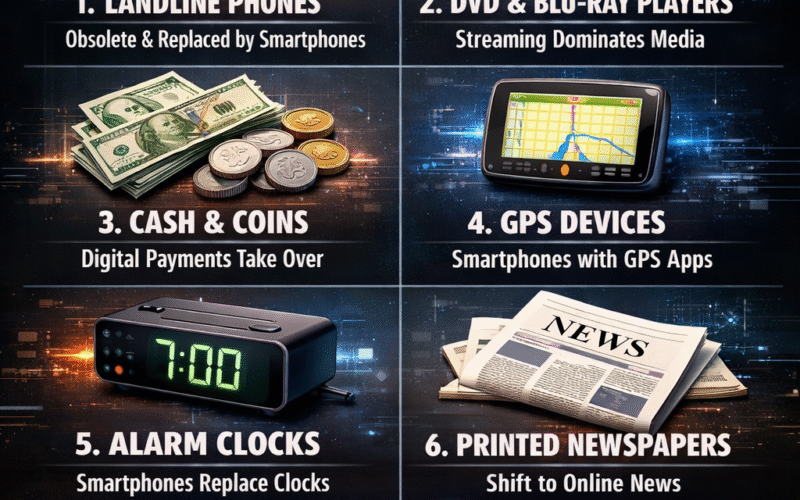
The Great Tech Purge: 8 Everyday Items That Could Disappear by 2030
The pace of technological change is no longer gradual—it’s accelerating at an unprecedented rate. What once took decades to evolve now happens in just a few years. As we approach 2030, the line between the physical and digital worlds is rapidly dissolving, reshaping how we interact with everyday objects.
Table Of Content
- The Great Tech Purge: 8 Everyday Items That Could Disappear by 2030
- 1. Traditional Mechanical Keys
- 2. Static Passwords
- 3. Physical Credit Cards
- 4. Remote Controls
- 5. Charging and Data Cables
- 6. Scheduled Television Channels
- 7. Physical Cash
- 8. External Hard Drives
- The Bigger Shift: From Ownership to Access
- Final Thoughts
Items that once felt essential—keys, wallets, remotes, even cables—are steadily being replaced by smarter, more seamless alternatives. The shift isn’t just about convenience; it’s about transforming how we live, access, and secure our daily lives.
Here’s a closer look at eight everyday technologies that are on track to become obsolete by the end of the decade.
1. Traditional Mechanical Keys
The familiar jingle of keys in your pocket may soon be a thing of the past. Mechanical keys are being replaced by smart, connected access systems that eliminate the need for physical metal entirely.
Modern smart locks allow doors to be opened using smartphones, fingerprints, or even facial recognition. Instead of carrying keys, users rely on encrypted digital credentials stored securely on their devices.
One of the biggest advantages is control. You can lock or unlock your home remotely, grant temporary access to guests, or receive alerts if someone enters your space. This not only improves convenience but also enhances security by removing the risks associated with lost or duplicated keys.
2. Static Passwords
Remembering dozens of complex passwords is quickly becoming outdated. Traditional passwords are not only inconvenient but also vulnerable to hacking, phishing, and data breaches.
The future lies in passwordless authentication systems, often referred to as passkeys. These systems rely on biometric verification—such as fingerprints or facial recognition—combined with secure device-based encryption.
Instead of typing a password, your device confirms your identity locally and grants access. This approach dramatically reduces the risk of cyberattacks because there is no reusable “secret” that can be stolen.
In the coming years, logging into apps and websites will feel almost invisible—secure, instant, and effortless.
3. Physical Credit Cards
The shift away from physical wallets is already underway. While contactless cards are still common, even they are starting to feel unnecessary as digital payment systems take over.
Smartphones, smartwatches, and even wearable devices now allow users to pay with a simple tap—or no action at all in some cases. Advanced systems are enabling “invisible payments,” where transactions happen automatically as you leave a store.
These digital payments are more secure thanks to tokenization, which replaces your actual card number with a temporary digital code during transactions. This means your sensitive information is never directly exposed to merchants.
As adoption grows, carrying physical credit cards may soon feel as outdated as carrying checks.
4. Remote Controls
The days of searching for a lost remote control between couch cushions are numbered. Home entertainment and automation systems are evolving toward more intuitive interfaces.
Voice assistants, smartphone apps, and gesture-based controls are replacing traditional remotes. With a simple voice command, you can change channels, adjust volume, or dim the lights.
Smart homes are becoming increasingly interconnected, allowing a single device—or even your voice—to control multiple systems simultaneously. This reduces clutter and simplifies everyday interactions with technology.
Ultimately, the remote control is being replaced by something far more natural: human behavior.
5. Charging and Data Cables
Cable clutter has long been a source of frustration, but wireless technology is rapidly eliminating the need for physical connections.
Wireless charging is becoming faster and more efficient, while advancements in connectivity—such as high-speed Wi-Fi and cloud syncing—are reducing the need for data transfer cables altogether.
Instead of plugging in devices, users can simply place them on charging pads or rely on ambient charging solutions in the future. Data, meanwhile, is instantly accessible through the cloud, making physical transfers largely unnecessary.
The result is a cleaner, more streamlined environment with fewer points of failure.
6. Scheduled Television Channels
Traditional television broadcasting is fading as on-demand streaming becomes the dominant way people consume content.
Rather than waiting for a specific show to air at a scheduled time, viewers now expect instant access to what they want, when they want it. Streaming platforms are taking this further by using algorithms to curate personalized content feeds.
In the near future, content discovery will become even more advanced. AI-driven systems will anticipate your preferences, mood, and habits, delivering a continuous stream of tailored entertainment without the need to browse.
The concept of a fixed TV schedule may soon feel completely outdated.
7. Physical Cash
Cash usage has been steadily declining across the globe, driven by the rise of digital payment methods and mobile banking.
Contactless payments, peer-to-peer transfer apps, and digital currencies are making transactions faster and more convenient. In many regions, cash is already used for only a small fraction of everyday purchases.
Looking ahead, central bank digital currencies (CBDCs) and other digital financial systems could further reduce the need for physical money. Transactions will become instant, traceable, and seamlessly integrated into everyday life.
While cash may not disappear entirely, its role is likely to diminish significantly by 2030.
8. External Hard Drives
The way we store data is undergoing a major transformation. External hard drives, once essential for backups and storage, are being replaced by cloud-based solutions.
Cloud storage offers the ability to access files from anywhere, on any device, without the need for physical hardware. As internet speeds improve and connectivity becomes more widespread, cloud services are becoming faster, more reliable, and more secure.
One of the biggest advantages is redundancy. Files stored in the cloud are backed up across multiple locations, reducing the risk of data loss due to hardware failure or theft.
In a world where data exists “everywhere yet nowhere,” physical storage devices are becoming increasingly unnecessary.
The Bigger Shift: From Ownership to Access
What ties all these changes together is a broader transformation in how we interact with technology. We are moving away from owning physical objects and toward accessing digital services.
Instead of carrying items, we carry capabilities—stored securely on our devices and accessible at any moment. Technology is becoming less visible but more powerful, working quietly in the background to simplify our lives.
This shift raises important questions about privacy, security, and dependence on digital systems. However, it also offers undeniable benefits: convenience, efficiency, and a more connected world.
Final Thoughts
The Great Tech Purge: 8 Everyday Items That Could Disappear by 2030.
While there may be a sense of nostalgia for these physical objects, the transition points toward a future where technology is less intrusive and more intuitive.
The question is no longer whether these changes will happen—it’s how quickly we’ll adapt to a world without wires, wallets, or keys.





No Comment! Be the first one.