


Digital Immortality: Is Neuralink the Bridge to “You 2.0”?
Introduction: The End of Biology as a Limitation
For as long as humans have existed, biology has defined the boundaries of life. Aging, disease, and death have remained unavoidable realities—our built-in “expiration date.” Even with modern medicine extending life expectancy, the fundamental limitation remains unchanged: the human body is fragile, finite, and ultimately temporary.
Table Of Content
- Introduction: The End of Biology as a Limitation
- The Vision: Uploading the Self
- Neuralink: Building the Bridge
- The Technical Reality: How Close Are We?
- The Philosophical Glitch: Are You Still You?
- Ethical and Societal Implications
- 1. Inequality
- 2. Legal Identity
- 3. Meaning of Life
- The Bottom Line: Between Science and Speculation
- Conclusion: The Future of “You”
But what if death isn’t a certainty? What if it’s simply a limitation of outdated biological hardware—one that could eventually be upgraded or replaced?
This question is no longer confined to science fiction. With rapid advancements in neurotechnology, particularly from companies like Neuralink led by Elon Musk, the idea of “digital immortality” is entering serious scientific and philosophical discussions.
The Vision: Uploading the Self
At the core of digital immortality lies a bold and controversial concept: the ability to preserve and transfer human consciousness into a non-biological form.
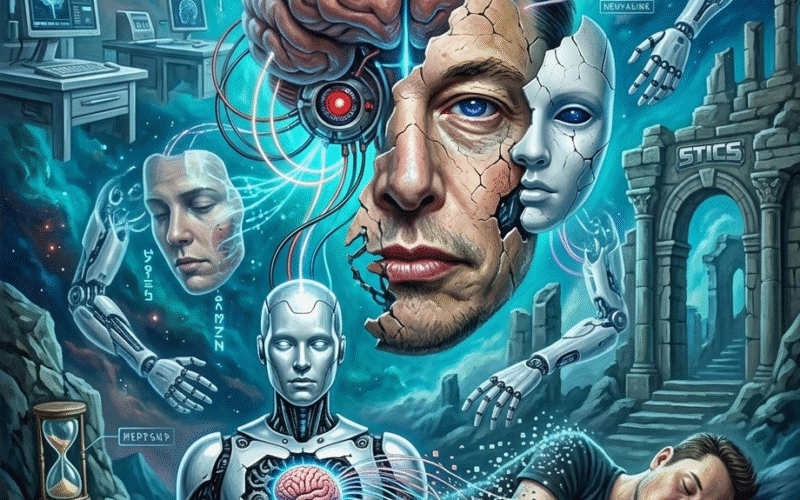
Imagine a future where your memories, personality, and cognitive patterns could be extracted from your brain and uploaded into a digital system—or even embodied within a humanoid robot. This isn’t just about extending lifespan; it’s about redefining what it means to be human.
In this hypothetical “You 2.0” scenario, your new existence could include:
- Freedom from aging: No cellular decay, no disease, no physical deterioration.
- Elimination of pain: The ability to control or entirely remove physical suffering.
- No need for sleep: Reclaiming nearly a third of your lifetime.
- Enhanced capabilities: Faster thinking, expanded memory, and seamless integration with digital systems.
In essence, your consciousness would shift from a biological substrate—neurons and chemistry—to a digital one—code and circuitry.
Neuralink: Building the Bridge
The biggest challenge in achieving digital immortality has always been the interface between the human brain and machines. How do you translate the complexity of neural activity into digital information?
This is where Neuralink comes in.
Neuralink is developing high-bandwidth brain–computer interfaces (BCIs) designed to connect the human brain directly to computers. These devices aim to read and write neural signals with unprecedented precision.
While current applications are focused on medical uses—such as helping people with paralysis regain movement or communication—the long-term vision is far more ambitious. The goal is to:
- Map the brain’s neural patterns in extreme detail
- Decode how memories and personality are stored
- Enable real-time interaction between human cognition and digital systems
If successful, this technology could theoretically allow for the preservation—and eventual replication—of human consciousness.
The Technical Reality: How Close Are We?
Despite the excitement, it’s important to separate vision from current capability.
Today’s neuroscience still lacks a complete understanding of how consciousness arises from neural activity. While we can observe and influence brain signals, we are far from being able to fully map or replicate a human mind.
Key challenges include:
- Complexity of the brain: The human brain contains roughly 86 billion neurons with trillions of connections.
- Encoding of identity: We still don’t fully understand how memories, personality, and self-awareness are stored.
- Dynamic processes: The brain is not static; it constantly changes and adapts.
Neuralink and similar technologies represent an important step forward—but they are only the beginning of a much longer journey.
The Philosophical Glitch: Are You Still You?
Even if the technology becomes possible, it introduces a profound philosophical dilemma often referred to as the “Transporter Paradox.”
Consider this scenario:
Your brain is scanned, and a perfect digital version of your consciousness is created. That digital version thinks like you, remembers your life, and believes it is you.
But your biological body still exists.
So which one is the “real” you?
This raises several unsettling questions:
- Is identity tied to continuity of consciousness or to physical existence?
- If a copy of you exists, does your original self still matter?
- Would “you” experience the transition—or would your consciousness simply end while a replica continues?
From one perspective, digital immortality might not be immortality at all—it could simply be replication.
Ethical and Societal Implications
Beyond the philosophical debate, digital immortality would fundamentally reshape society.
1. Inequality
Access to such technology would likely be limited—at least initially—to those who can afford it. This could create a divide between “biological humans” and “enhanced” or digital individuals.
2. Legal Identity
Would a digital consciousness have rights? Could it own property, vote, or be held accountable under the law?
3. Meaning of Life
If death is no longer inevitable, how does that affect motivation, purpose, and human experience?
Mortality has historically shaped culture, ambition, and relationships. Removing it could redefine everything from career paths to personal values.
The Bottom Line: Between Science and Speculation
The idea of digital immortality sits at the intersection of cutting-edge science and philosophical speculation.
On one hand, technologies like Neuralink are making real progress in connecting the brain to machines. On the other, the concept of fully transferring consciousness remains deeply uncertain.
What is clear, however, is that humanity is approaching a turning point.
For the first time, we are seriously exploring the possibility that death might not be an absolute limit—but a problem to be solved.
Conclusion: The Future of “You”
Whether digital immortality becomes reality in decades, centuries, or never, the conversation itself is transformative.
It forces us to confront fundamental questions:
- What does it mean to be human?
- Is consciousness transferable—or inherently biological?
- And ultimately, if a perfect copy of you exists… is that enough?
“You 2.0” may one day walk, think, and speak exactly like you.
But whether it is you—or just something that believes it is—remains the ultimate unanswered question.
Until then, the boundary between life and technology continues to blur, and the future of human existence remains one of the most fascinating frontiers we have yet to explore




No Comment! Be the first one.