


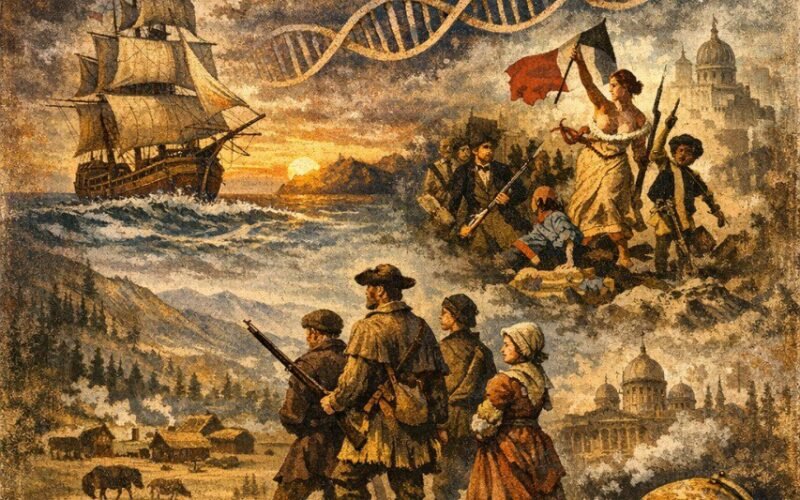
When we look at human history or the biodiversity of life on Earth, it may initially seem that the distribution of genetic traits—or even certain social and political patterns—simply resulted from long processes of evolution and natural selection.
Table Of Content
- Cheetahs
- Darwin’s Finches in the Galápagos Islands
- Animals on Isolated Islands
- Tay-Sachs Disease
- Huntington’s Disease in Venezuela
- Ellis–van Creveld Syndrome
- Indigenous Peoples of the Americas
- Iceland
- South Africa
- European Royal Families
- Aristocratic Lineages
- Inclusive Settler Societies
- Extractive Colonial Societies
However, population genetics reveals that other mechanisms also play a crucial role in shaping this diversity.
One of the most important of these mechanisms is known as the Founder Effect.
This concept describes a phenomenon that occurs when a small group of individuals separates from a larger population to establish a new community. Because the group is small, the genetic makeup of the new population may differ significantly from that of the original population—not necessarily because of natural selection, but due to statistical chance.
Over time, this effect can lead to clear genetic differences between populations. It may even contribute to the emergence of hereditary diseases or influence long-term economic and political patterns.
In this article, we explore the founder effect from a broad perspective—spanning genetics, history, animals, geopolitics, and political economy.
What Is the Founder Effect in Population Genetics?
The founder effect is a specific form of genetic drift.
Genetic drift is a random process that changes the frequency of genetic variants (alleles) within a population over time, particularly when the population size is small.
When a small group separates from a larger population to form a new community, the genes present in that group represent only a small sample of the original population’s genetic diversity.
As a result, several outcomes may occur:
-
Some genes that were rare in the original population may become very common in the new population.
-
Other genes may disappear entirely.
-
Certain genetic mutations may become more frequent, potentially increasing the prevalence of hereditary diseases.
Over generations, these differences can grow, eventually producing significant genetic distinctions between populations.
The Difference Between the Founder Effect and a Population Bottleneck
Although the two concepts are closely related, there is an important distinction.
A population bottleneck occurs when a population suddenly declines due to a catastrophic event such as a natural disaster, epidemic, or war. This sharp reduction results in the loss of a large portion of genetic diversity.
The founder effect, on the other hand, occurs when a small group migrates and establishes a new population.
In both cases, genetic diversity decreases—but the historical mechanism behind the reduction is different.
The Founder Effect in the Animal World
The founder effect is not limited to humans; it can be observed in many animal species.
Cheetahs
Cheetahs are a well-known example of extremely low genetic diversity.
Genetic studies suggest that cheetahs experienced a severe population bottleneck in the past, drastically reducing their genetic variation.
Today, cheetahs can accept skin grafts from one another with unusual ease compared to other mammals because their genetic makeup is so similar.
Darwin’s Finches in the Galápagos Islands
When a small group of birds arrived in the Galápagos Islands millions of years ago, they established new populations.
Over time, these birds evolved into multiple distinct species—a phenomenon that helped Charles Darwin develop the theory of evolution.
Animals on Isolated Islands
Islands provide ideal conditions for the founder effect.
When a small group of animals reaches an isolated island, unique traits may evolve due to genetic isolation and limited gene flow.
The Founder Effect and Genetic Diseases
One of the most important consequences of the founder effect is the increased prevalence of certain hereditary diseases in specific populations.
Tay-Sachs Disease
This genetic disorder occurs at higher rates among certain Ashkenazi Jewish populations.
The reason is linked to the founder effect in relatively small, historically isolated communities.
Huntington’s Disease in Venezuela
In one region of Venezuela, the highest rates of Huntington’s disease in the world have been recorded.
Research suggests the disease spread through descendants of a single woman who lived in the nineteenth century.
Ellis–van Creveld Syndrome
This rare genetic disorder occurs more frequently in isolated communities such as the Amish in North America.
The Founder Effect in the History of Nations and Peoples
Human migrations throughout history have played a major role in spreading the founder effect.
Indigenous Peoples of the Americas
Genetic studies suggest that the first humans who reached the Americas via the Bering Land Bridge were a relatively small population.
Because of this event, certain genetic traits—such as blood type O—became particularly common among many Indigenous American populations.
Iceland
Iceland was settled in the 9th century by a limited number of settlers from Scandinavia.
As a result, modern Icelanders form a relatively genetically cohesive population, making Iceland one of the most important places in the world for studying human genetics.
South Africa
Some genetic mutations among Afrikaners are believed to trace back to a small number of early European settlers.
The Founder Effect and Historical Figures
In certain cases, the spread of genetic traits or diseases can be linked to specific individuals in history.
European Royal Families
The genetic disorder hemophilia spread among several European royal families during the 19th century.
Researchers believe the mutation originated with Queen Victoria.
Because of political marriages between royal families, the condition spread across several European dynasties.
Aristocratic Lineages
In royal or aristocratic societies where endogamous marriage (marriage within a restricted social group) is common, the founder effect can become especially visible.
The Founder Effect and Geopolitics
At first glance, the founder effect may seem like a purely biological concept. However, it can have indirect consequences for geopolitics.
Communities established by small groups of settlers may develop distinctive cultural, linguistic, or genetic identities.
These differences can influence:
-
National identity formation
-
Ethnic conflicts
-
Immigration policies
For example, settler societies in the Americas, Australia, and New Zealand emerged from relatively limited waves of migration, which later shaped their social and political structures.
The Founder Effect in Political Economy
From the perspective of political economy, the founder effect may have long-term implications for economic institutions.
Some scholars in institutional economics argue that the social and cultural characteristics of early settlers can influence the type of institutions that later develop.
When a small group establishes a new society, its values and organizational patterns may become the foundation for future institutions.
This idea is sometimes used to explain differences in economic development among countries.
For example:
Inclusive Settler Societies
Some societies founded by settlers eventually developed more inclusive institutions.
Examples include Australia and New Zealand, where European settlers quickly became the demographic majority.
Extractive Colonial Societies
In contrast, some colonial societies were structured around extractive economic systems.
Examples include many Spanish colonies in Latin America, where colonial institutions concentrated wealth and power in small elites.
The Founder Effect and Human Evolution
From an evolutionary perspective, the founder effect played an important role in the global spread of humans.
Every wave of human migration represented a new genetic experiment.
Small groups of humans moved into new environments, reproduced, and eventually established new populations.
Over thousands of years, this process contributed to the genetic diversity we observe among human populations today.
Why Understanding the Founder Effect Matters Today
Understanding the founder effect is not just a theoretical issue in genetics—it has important practical applications.
It plays a role in:
-
Genetic medicine
-
Epidemiology
-
Biodiversity research
-
Human history
-
Public health policy
By studying the founder effect, scientists can better understand how certain diseases spread and how demographic changes may influence the genetic future of humanity.
Conclusion
The founder effect demonstrates how a seemingly simple event—such as a small group of individuals migrating to a new place—can leave a profound imprint on the biological and social history of the world.
From animals on isolated islands to the spread of genetic diseases, and from the formation of nations to the evolution of political institutions, the founder effect reveals the deep connections between genes, history, economics, and society.
In a modern world characterized by rapid migration and demographic change, understanding these mechanisms remains essential for interpreting the past—and anticipating the future of human diversity.







No Comment! Be the first one.