



A CIA Confidential Document on the Biochemical Similarities Between Cancer and Parasites
In the archives of declassified documents from the Central Intelligence Agency, numerous scientific reports can be found. These reports were not initially intelligence research but were often translations of foreign scientific articles aimed at tracking scientific developments in competing nations during the Cold War.
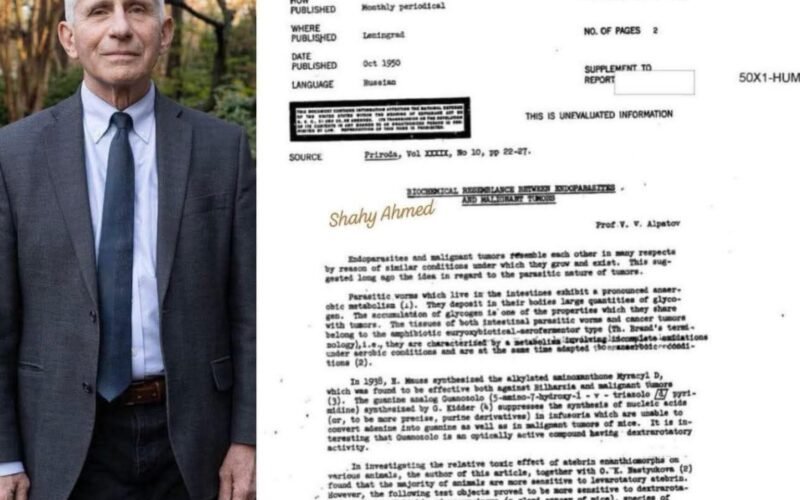
One such document concerns a Soviet scientific article from 1950 discussing an intriguing concept: the biochemical similarities between internal parasites and malignant tumors. The CIA translated this article from Russian and included it in its scientific reports.
In this article, we will cover:
-
A translation of the document’s content
-
Historical context of the document
-
An explanation of the scientific idea discussed in the article
-
Clarification on whether this implies cancer is actually parasitic
First: Key Details of the Document
The document is classified as Confidential and is a report issued by the Central Intelligence Agency.
Details listed in the report:
-
Agency: Central Intelligence Agency
-
Report type: Information derived from foreign documents or radio broadcasts
-
Source country: Soviet Union
-
Scientific field: Medicine and biological sciences
-
Original publication location: Leningrad
-
Original publication date: October 1950
-
Original language: Russian
-
CIA report distribution date: February 16, 1951
-
Number of pages: 2
The original source of the article was a Soviet scientific journal:
Priroda
Published in:
Volume 29 – Issue 10 – Pages 22–27
The report includes a crucial note:
This information has not been evaluated.
This means the CIA did not analyze or verify the scientific accuracy of the findings but simply translated the article for internal scientific reference.
Second: Article Title and Author
The title of the Soviet scientific article is:
“Biochemical Similarities Between Internal Parasites and Malignant Tumors”
Author:
Professor V. V. Alpatov, a Soviet biologist specializing in biological research.
Third: Translation of the Main Idea
The article discusses the scientific hypothesis that there are biological and biochemical similarities between internal parasites and cancer cells.
The author begins with an important observation:
Internal parasites and malignant tumors resemble each other in many ways due to similar conditions under which they grow and exist.
He suggests that this resemblance leads to the idea that tumors may possess parasite-like characteristics at the biochemical level.
It is crucial to note that the author does not claim that cancer is an actual parasite. Rather, he is highlighting biochemical and metabolic similarities.
Fourth: Similarities in Metabolism
One of the key points in the article is the way cells produce energy.
Parasites living in the intestines rely on anaerobic metabolism, which allows them to produce energy without using oxygen.
The article notes that these organisms store large quantities of glycogen, a form of sugar storage inside cells.
Interestingly, cancer cells exhibit similar behavior under certain conditions.
Fifth: Tumors’ Reliance on Sugar Breakdown
The author emphasizes that malignant tissues share with some parasites a specific type of metabolism called:
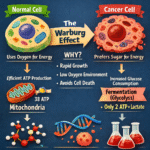
glycolytic-fermentative metabolism
This means cells rely heavily on breaking down glucose for energy rather than using oxygen efficiently like normal cells.
This phenomenon later became well-known in oncology as the Warburg Effect, described by the German scientist Otto Warburg. It refers to the tendency of cancer cells to consume large amounts of glucose even in the presence of oxygen.
Sixth: Reference to Chemical Compounds
The article also discusses certain chemical compounds under study at the time.
The author mentions that researcher M. Moses synthesized a compound in 1938 called:
Kymycyl D
This compound was found to have effects against some bacteria and certain malignant tumors.
Additionally, the article notes that chemical derivatives such as those based on pyridine could potentially be converted into compounds active against cancer cells.
However, these were preliminary observations, not approved treatments.
Seventh: Differences in Response Between Tumors and Parasites
The article further explains experiments on the toxic effects of certain compounds on animals.
It was observed that some intestinal parasitic organisms responded differently to these compounds compared to tumor tissues.
From this, the author concludes that:
-
Malignant tumors
-
Internal parasites
can be distinguished from normal tissues based on their differential response to chemical compounds.
Eighth: Historical Context of the Document
To understand this document properly, it is important to consider its historical context.
During the Cold War, both the United States and the Soviet Union sought to monitor the scientific progress of their rival.
As a result, the Central Intelligence Agency collected and translated:
-
Scientific articles
-
Academic books
-
Research reports
published in the Soviet Union, and distributed these translations to U.S. scientists and researchers.
In other words, this document is not a secret discovery about cancer but merely a translation of an openly published Soviet scientific article.
Ninth: Does This Mean Cancer is Parasitic?
It is important to clarify a common misconception circulating online.
Some interpret this document as proof that:
Cancer is a parasite within the human body.
This is incorrect. The article only highlights similarities in certain biochemical characteristics between:
-
Cancer cells
-
Certain parasitic organisms
Modern medicine clearly establishes that cancer is:
an abnormal, uncontrolled growth of the body’s own cells caused by genetic mutations.
Tenth: Why This Idea Sometimes Appears in Discussions
Although cancer is not parasitic, certain characteristics can superficially resemble parasites:
-
Cancer cells consume body resources rapidly
-
They grow and divide quickly
-
They can spread to other organs
-
They may evade the immune system
These behaviors may make cancer appear “parasite-like,” but metabolic similarity does not mean they are biologically identical.
Conclusion
The CIA document translated in the early 1950s is not evidence of a conspiracy or secret cancer treatment.
It is simply a translation of an old Soviet scientific article discussing research on similarities between:
-
Internal parasites
-
Malignant tumors
The purpose of such documents was to monitor global scientific developments during a period of intense political and scientific competition in the 20th century.
Today, oncology has advanced considerably, providing a much deeper understanding of the genetic and biological mechanisms that lead to cancer.






No Comment! Be the first one.