



Nikola Tesla’s Thought Camera: Visualizing the Human Mind
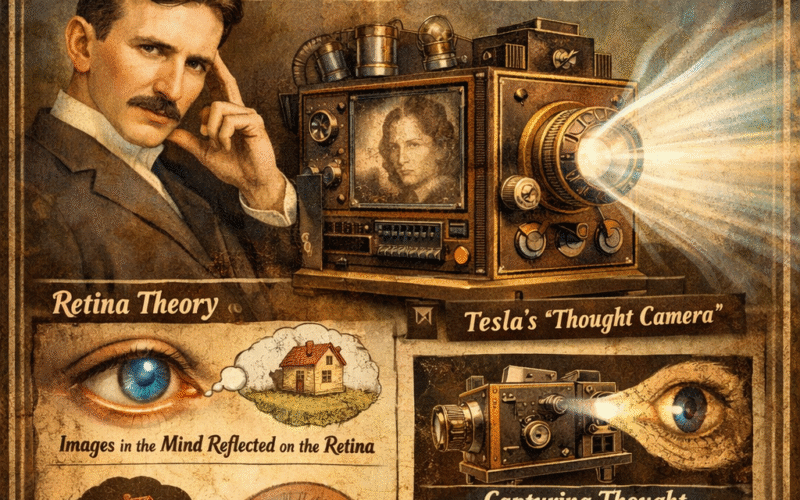
Nikola Tesla’s “Thought Camera” remains one of his most enigmatic and provocative concepts. It wasn’t merely a photographic device; it was a bold attempt to externalize the human intellect and transform mental imagery into visible pictures for the world to see.
Table Of Content
The following article explores the history, the mechanism, and the fascinating theory behind Tesla’s vision of photographing thoughts.
1. History and Public Announcement
Unlike his revolutionary work with Alternating Current (AC), Tesla never completed a functional prototype of this camera. It remained in the stages of theorization and research for several decades.
-
Origins: The seeds of the idea date back to the 1890s during Tesla’s intense experimental period.
-
Official Statement: In 1933, during an interview on his 77th birthday with the Kansas City Journal-Post, Tesla officially revealed he was working on a device to photograph thoughts.
-
The Famous Quote: Tesla stated: “I became convinced that a definite image formed in thought must, by reflex action, produce a corresponding image on the retina, which might be read by a suitable apparatus.”
2. The Mechanism of the “Thought Camera”
Tesla’s concept for the device was based on a principle he called “Reverse Nerve Reflex.”
The Proposed Scientific Principle:
In normal vision, light hits the retina, and the signal travels through the optic nerve to the brain for interpretation. Tesla hypothesized that this process could work in reverse:
-
When a person imagines an idea or a picture with great intensity, the brain sends neural impulses back toward the eye.
-
This thought appears as a “phantom” or microscopic projection on the retina.
-
The device would use ultra-sensitive lenses to scan the surface of the retina, capture this reflection, and project it onto a screen.
3. How Tesla Discovered This: The Personal Experience
Tesla explained that his discovery was not initially based on mathematical equations, but on a hyper-sensory experience he had dealt with since childhood:
-
Voluntary Visual Hallucinations: Tesla possessed a rare gift (scientifically known as a hyper-active Eidetic Memory). He could see machines and inventions before his eyes in vivid detail, as if they were solid 3D objects, long before he ever put pen to paper.
-
The Crucial Observation: He noticed that when he focused intensely on an object and then closed his eyes or looked away, a “persistent image” of the object remained on his retina for a short time. He concluded that “thought” is not just electrical activity in the brain, but a physical process that leaves a tangible imprint on the optic nerve.
-
The Verification: Tesla believed that if “imagination” is the retrieval of stored images, the brain must use the same neural pathways as vision to re-project those images onto the “screen” of the eye.
4. The Philosophical and Scientific Logic
Tesla viewed the human being as a “Self-propelling automaton” that responds only to external stimuli. Based on this:
-
Every thought is a reaction to an external image.
-
Since action and reaction are equal, the (internal) thought must produce a (physical) image on the retina.
Historical Note: Many researchers after Tesla’s death explored “Thoughtography” (such as Ted Serios in the 1960s), but none achieved the technical precision or scientific grounding Tesla envisioned.





No Comment! Be the first one.