


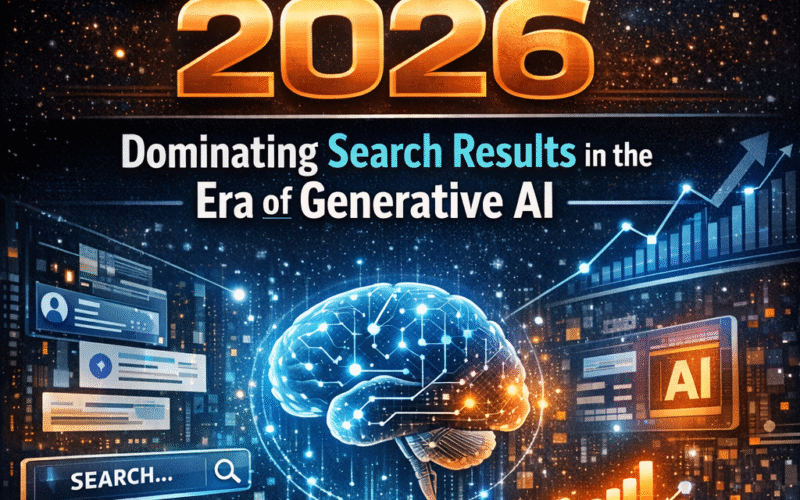
The Ultimate Guide to SEO in 2026: Dominating Search Results in the Era of Generative AI
The era of simple “keyword stuffing” is long gone. In 2026, search engines have evolved from mere link indexes into “Intelligent Answer Engines.” If you are still relying on 2023 or 2024 strategies, you are likely missing out on over 70% of your potential visibility. This guide explores the radical shifts in the landscape and how to adapt to them.
Table Of Content
- Chapter 1: The GEO Revolution (Generative Engine Optimization)
- What is GEO?
- Chapter 2: E-E-A-T and the Challenge of Synthetic Content
- 1. Experience (The Leading ‘E’)
- 2. Topical Authority (The Clusters)
- Chapter 3: Technical SEO in the Age of AI Agents
- The Criticality of Structured Data (Schema Markup)
- Instantaneous Interaction (INP)
- Chapter 4: Visual and Voice Search Optimization
- Chapter 5: Backlink Strategy in 2026
- Chapter 6: Social SEO (The New Discovery)
- Conclusion: The Roadmap to Success
Chapter 1: The GEO Revolution (Generative Engine Optimization)
Search is no longer confined to the traditional Google interface. Today, features like SGE (Search Generative Experience) and AI Overviews dominate the top of the Search Engine Results Pages (SERPs).
What is GEO?
GEO stands for Generative Engine Optimization. Instead of just aiming for “Rank 1,” the new goal is to be “cited” within the AI-generated response.
-
The “Direct Answer” Principle: Your articles must now lead with an “AI Snapshot” paragraph—a concise, definitive answer of about 50 words at the very beginning.
-
Data Citation: Generative engines crave hard data.
-
Structural Formatting: Heavily utilize tables and bulleted lists. AI algorithms find these much easier to parse and convert into text or voice responses.
Chapter 2: E-E-A-T and the Challenge of Synthetic Content
In 2026, AI-generated content has become a “cheap commodity.” To counter this, Google has drastically increased the value placed on the Human Touch.
1. Experience (The Leading ‘E’)
This is the most critical factor today. Google prioritizes content that proves the author has “first-hand experience.”
-
The Strategy: If you are reviewing a product, listing specs isn’t enough. You must include original photos, videos of you using the product, and mentions of specific “real-world” pros and cons that an AI couldn’t possibly know.
2. Topical Authority (The Clusters)
Writing one good article is no longer sufficient. You must build Topic Clusters. If your site is about “Coffee,” you must cover everything: from bean varieties and roasting techniques to the history of specific farms. This establishes your site as a “Subject Matter Authority” in the eyes of the algorithm.
Chapter 3: Technical SEO in the Age of AI Agents
We are now in an era where users ask their AI assistants: “Google, book the cheapest flight to Dubai for next week.” In this scenario, the user doesn’t visit your site—the AI Agent does.
The Criticality of Structured Data (Schema Markup)
In 2026, Schema is your website’s “ID Card.” Without it, you are invisible to AI. You must implement advanced types such as:
-
ProductGroup: For variable products. -
Speakable: To enable voice assistants to read your content. -
Verified Review: To boost trust and credibility.
Instantaneous Interaction (INP)
Core Web Vitals now focus heavily on INP (Interaction to Next Paint). Any delay in how your site responds to a user’s click will result in a sharp drop in rankings.
Chapter 4: Visual and Voice Search Optimization
By 2026, over 50% of searches are conducted via voice or camera (Google Lens).
-
Voice Search: People don’t search for “Best restaurant Dubai” via voice; they ask, “Where can I get the best shawarma near me right now?” Target long-tail, conversational keywords.
-
Visual Search: Ensure every image has highly descriptive Alt Text and is delivered in ultra-high quality (WebP or AVIF) so AI can accurately map your visual content to user queries.
Chapter 5: Backlink Strategy in 2026
Is link building dead? Absolutely not, but the quality metric has shifted entirely.
-
Contextual Links: A link from an article discussing your specific niche is 100x more valuable than a “Footer” or “Sidebar” link.
-
Social Signals: Google now weighs mentions from platforms like Reddit, LinkedIn, and X (formerly Twitter) heavily, viewing them as evidence of a “Living Community” engaging with your brand.
Chapter 6: Social SEO (The New Discovery)
In 2026, Gen Z and Gen Alpha use TikTok, Instagram, and YouTube as their primary search engines.
-
Your videos must appear in Google Video search results.
-
Using keywords in video captions and “On-screen Text” is now a mandatory part of a holistic SEO strategy.
Conclusion: The Roadmap to Success
To summarize the 2026 strategy into actionable steps:
-
Be Human: Infuse your content with personal opinions and real-world trials.
-
Be Organized: Use Schema and tables to make your data “AI-friendly.”
-
Be an Authority: Don’t write scattered topics; build a comprehensive library around your niche.
-
Be Instant: Ensure your user experience is seamless and lightning-fast.
SEO is not dead; it is in its most vibrant era for those who understand the language of the machine and the soul of the human.





No Comment! Be the first one.