



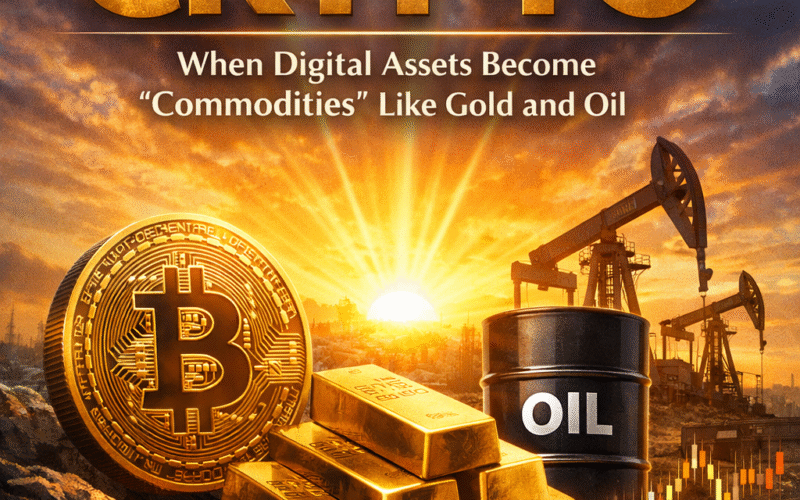
A New Dawn for Crypto: When Digital Assets Become “Commodities” Like Gold and Oil
In a historic move that could end decades of legal ambiguity and reshape the global financial system, U.S. regulatory bodies (led by the SEC and CFTC) have begun adopting definitive classifications for digital assets.
Table Of Content
- Why is This Classification a “Market Earthquake”?
- The Stories of the Assets: From Concept to Commodity
- 1. Bitcoin (BTC) – The Digital Gold
- 2. Ethereum (ETH) – The World’s Computer
- 3. Utility Coins: Bitcoin Cash (BCH) & Litecoin (LTC)
- 4. Ethereum Rivals: Solana (SOL) & Cardano (ADA)
- 5. Ripple (XRP) – The Banking Bridge
- 6. Meme Coins: Dogecoin (DOGE) & Shiba Inu (SHIB)
- 7. Infrastructure Assets (LINK, DOT, AVAX)
- Ethereum in Action: More Than Just Speculation
- Example: A Smart Crop Insurance Platform
- Conclusion: Are We Witnessing a New Bull Run?
This shift is not merely a change in terminology; it is a formal recognition that cryptocurrencies are no longer “imaginary numbers” in cyberspace. Instead, they are now recognized as strategic assets subject to strict oversight, much like gold, crude oil, and wheat.
Why is This Classification a “Market Earthquake”?
This new designation clearly separates coins deemed “Securities” (which face strict issuance rules and potential legal scrutiny) from those classified as “Digital Commodities.” Being under the CFTC umbrella provides the market with three essential pillars that were previously missing:
-
Absolute Legal Clarity: It reduces the “gray area” that once made major financial institutions and massive investment portfolios hesitant to enter the market for fear of regulatory backlash.
-
The Era of Institutional ETFs: This classification paves the way for a wider variety of Exchange-Traded Funds (ETFs), allowing trillion-dollar liquidity to flow into the market beyond just Bitcoin and Ethereum.
-
A Shield for Innovation: It protects projects from “unregistered securities” lawsuits—the very dilemma that stifled major players like Ripple (XRP) for years.
The Stories of the Assets: From Concept to Commodity
Every coin mentioned in this transition has a journey that began with technical ambition and ended with a “Commodity” status:
1. Bitcoin (BTC) – The Digital Gold
Born in 2009 by the mysterious “Satoshi Nakamoto” as a direct response to the global financial crisis. Its goal was a decentralized financial system. Today, Bitcoin is the only asset everyone agrees has been a “commodity” (a store of value) since day one.
2. Ethereum (ETH) – The World’s Computer
Launched by “Vitalik Buterin” in 2015, it did more than offer payments; it invented “Smart Contracts.” Its recent classification as a commodity is a massive victory for the crypto community, ending the long-standing debate over its legal identity.
3. Utility Coins: Bitcoin Cash (BCH) & Litecoin (LTC)
-
BCH: Forked from Bitcoin in 2017 to make daily transactions faster and cheaper.
-
LTC: Known as the “Silver to Bitcoin’s Gold,” launched by Charlie Lee in 2011 to be a lighter, faster version of the original.
4. Ethereum Rivals: Solana (SOL) & Cardano (ADA)
-
Solana: Represents “Ultra-Speed,” aiming to process thousands of transactions per second, rivaling traditional payment giants.
-
Cardano: The “Scientific Approach” project, where every update undergoes rigorous academic peer review before implementation.
5. Ripple (XRP) – The Banking Bridge
XRP’s story is the most dramatic, having fought one of the fiercest legal battles in crypto history against the SEC to prove it is a tool for international banking transfers rather than a corporate security.
6. Meme Coins: Dogecoin (DOGE) & Shiba Inu (SHIB)
What started as a “joke” to mock the market turned into legitimate digital assets with billion-dollar market caps, thanks to the support of Elon Musk and massive communities. They are now being integrated into recognized asset classes.
7. Infrastructure Assets (LINK, DOT, AVAX)
-
Chainlink: Acts as the “Bridge” feeding real-world data into smart contracts.
-
Polkadot: Aims to connect different blockchains so they can communicate seamlessly.
-
Avalanche: Provides high-speed, secure solutions for financial institutions.
Ethereum in Action: More Than Just Speculation
To understand why Ethereum is classified as a commodity (like oil), consider this real-world example:
Example: A Smart Crop Insurance Platform
Imagine a farmer insured against drought via the Ethereum network:
The Smart Contract: A code is programmed: “If the temperature exceeds 45°C for 3 consecutive days, release the compensation immediately.”
Execution: Once satellite data confirms the heat (via Oracles), the contract automatically sends funds to the farmer’s wallet—no human approval or bank managers required.
In this scenario, ETH is the “Gas” (fuel) required by the engine to execute the task. Scientifically, the cost of this operation is calculated as:
Conclusion: Are We Witnessing a New Bull Run?
Moving these assets under the “Digital Commodity” umbrella means “Safe-Haven Investing” is no longer exclusive to gold and traditional stocks. We are standing at a new gateway where banks and hedge funds will begin injecting unprecedented liquidity, viewing crypto as a core component of the global investment portfolio.
Do you believe this classification will make cryptocurrencies less volatile in the future? Let us know in the comments.




No Comment! Be the first one.