



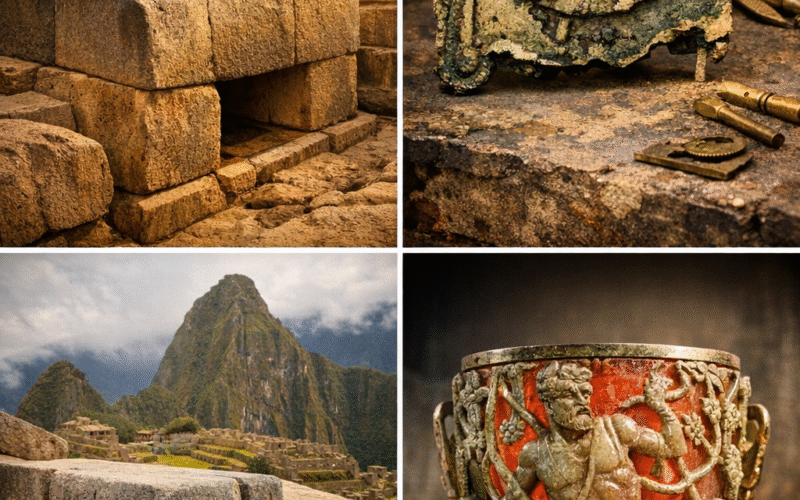
Ancient Technologies Ahead of Their Time: Engineering Marvels Science Still Can’t Fully Replicate
For a long time, ancient civilizations were viewed as primitive societies. However, ongoing archaeological discoveries prove that our ancestors possessed “technologies” that we are still struggling to decode, even in the age of Artificial Intelligence. From biochemistry to celestial engineering, we explore the most fascinating lost technologies that have baffled modern scientists.
Table Of Content
- 1. Greek Fire: The Byzantine Empire’s Secret Weapon
- 2. The Antikythera Mechanism: The World’s First Analog Computer
- 3. The Lycurgus Cup: Nano-Technology in Ancient Rome
- 4. Damascus Steel (Wootz Steel): The Unbreakable Blades
- 5. Maya Blue: The Pigment That Defies Time
- 6. Polygonal Masonry (The Inca): Earthquake-Proof Stones
- 7. Etruscan Gold Granulation: Micro-Jewelry Mastery
- Bonus: More Ancient Wonders
1. Greek Fire: The Byzantine Empire’s Secret Weapon
Greek Fire was the “napalm” of the Middle Ages. Used by the Byzantines in naval battles, this terrifying substance could burn on top of water—in fact, water often intensified the flames.
-
The Mystery: Despite countless attempts, modern chemists have been unable to recreate the exact formula (believed to be a mix of petroleum, sulfur, and quicklime).
2. The Antikythera Mechanism: The World’s First Analog Computer
Found in a shipwreck off a Greek island, this device consists of a complex system of bronze gears dating back over 2,000 years.
-
The Function: It was used to calculate astronomical positions and predict solar and lunar eclipses with startling accuracy.
-
The Shocking Fact: The technology required to build these gears did not reappear in human history for another 1,500 years, until the advent of Swiss clockmaking.
3. The Lycurgus Cup: Nano-Technology in Ancient Rome
This Roman chalice changes color from green to a glowing red when lit from behind.
-
The Science: In 1990, scientists discovered that the Romans were accidental pioneers of nanotechnology. They infused the glass with microscopic particles of silver and gold (roughly 70 nanometers in size). Controlling particles at this level requires precision that we only recently mastered.
4. Damascus Steel (Wootz Steel): The Unbreakable Blades
Damascus swords were legendary for their “watered” patterns and their ability to slice through a silk handkerchief mid-air without losing their edge.
-
Why we can’t replicate it: The secret lies in a microstructure containing “carbon nanotubes.” Although modern smiths try to imitate the look, the specific heat treatment and the original raw material (Indian Wootz steel) make creating an authentic match nearly impossible today.
5. Maya Blue: The Pigment That Defies Time
The Maya civilization used a unique blue pigment to decorate their temples and codices. This color has resisted time, humidity, and even chemical acids, remaining vibrant for over 1,000 years in the harsh Mesoamerican jungles.
-
The Secret: It is a complex chemical bond between “palygorskite” clay and the indigo plant. When heated at specific temperatures, the molecules lock together, creating a natural chemical shield.
6. Polygonal Masonry (The Inca): Earthquake-Proof Stones
In Machu Picchu and Sacsayhuamán, the Inca fit massive stones together with such precision that you cannot even slide a piece of paper between them.
-
The Challenge: They used no mortar (cement). Instead, they relied on complex geometric interlocking that allows the walls to “dance” during an earthquake and settle back into place without collapsing.
7. Etruscan Gold Granulation: Micro-Jewelry Mastery
The Etruscans (ancient inhabitants of Italy) excelled in a technique called Granulation—the process of soldering microscopic gold spheres onto jewelry without melting the base piece.
-
The Feat: These spheres are so tiny they look like gold dust. Even today, master jewelers find it extremely difficult to achieve the same level of purity and detail by hand.
Bonus: More Ancient Wonders
-
Roman Concrete: Unlike modern concrete that degrades after 50–100 years, Roman concrete (made with volcanic ash) grows stronger over time, especially when exposed to seawater.
-
The Iron Pillar of Delhi: A 1,600-year-old pillar in India that has never rusted. Ancient smiths created a high-phosphorus protective layer that has shielded the iron from corrosion for over a millennium.







No Comment! Be the first one.