



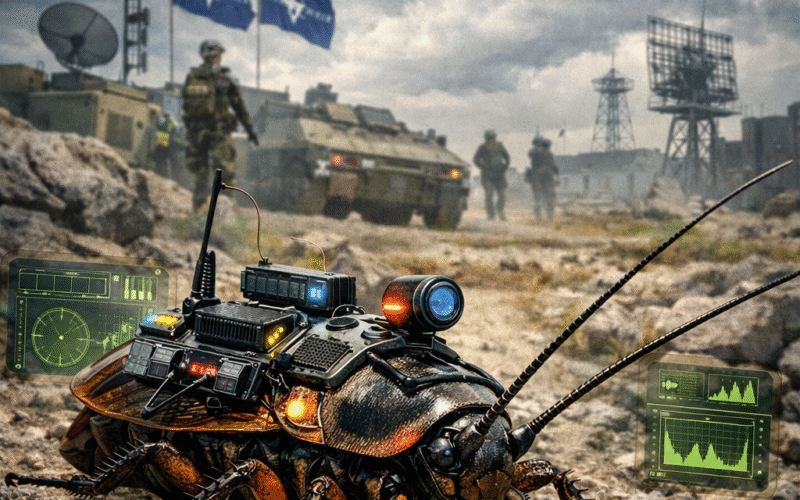
The Secret Army: Why NATO is Betting on “Cyborg Cockroaches” to Settle Future Wars
Table Of Content
In the rapidly evolving landscape of modern warfare, innovation often emerges from unexpected places. While much of today’s military advancement focuses on artificial intelligence, cyber capabilities, and autonomous drones, a quieter—and arguably more unsettling—development is taking shape. Instead of dominating the skies or infiltrating networks, the next generation of surveillance tools may operate unnoticed at ground level, hidden in plain sight. These tools are not machines in the traditional sense, but living organisms: insects transformed into bio-hybrid intelligence units.
Recent reports suggest that NATO, in collaboration with German biotechnology firm SWARM Biotactics, is exploring the use of modified Madagascar Hissing Cockroaches as part of a new class of covert surveillance assets. These so-called “cyborg cockroaches” represent a fusion of biology and technology, potentially redefining how intelligence is gathered in high-risk or inaccessible environments.
The Rise of Bio-Spies
The concept behind these bio-engineered agents is both simple and revolutionary. By equipping living insects with miniature electronic payloads—such as sensors, cameras, and communication devices—researchers aim to create stealth reconnaissance units capable of entering spaces that would be impossible for humans or conventional machines to access.
Unlike traditional drones or robotic systems, these insects require no complex locomotion systems or bulky power sources. Nature has already optimized them for survival, mobility, and adaptability. By leveraging these traits, engineers can focus solely on enhancing their capabilities with lightweight electronics.
These cyborg insects are designed to transmit real-time data, potentially allowing operators to monitor environments such as collapsed buildings, underground tunnels, or heavily guarded facilities. Their small size and natural behavior make them nearly invisible in chaotic or cluttered environments, offering a significant advantage in covert operations.
Why Cockroaches?
The choice of the Madagascar Hissing Cockroach is far from arbitrary. While the idea may provoke discomfort, these insects possess a unique combination of characteristics that make them ideal candidates for bio-hybrid systems.
Resilience:
Cockroaches are famously durable. They can survive in extreme conditions, including high levels of radiation and temperature fluctuations that would disable most electronic devices. This resilience ensures that the biological component of the system remains operational in harsh environments.
Agility:
Their compact, wingless bodies allow them to maneuver through tight spaces, including cracks, pipes, and debris. This makes them particularly valuable in urban warfare scenarios or disaster zones where access is limited.
Payload Capacity:
Compared to many other insects, Madagascar Hissing Cockroaches are relatively large and strong. This enables them to carry small electronic modules without significantly impairing their movement.
Self-Righting Ability:
One of the major challenges in small robotics is mobility after disruption. If a robot flips over, it may become useless. Cockroaches, however, can quickly right themselves and continue moving, ensuring mission continuity.
Together, these traits create a platform that is both efficient and difficult to replicate with purely mechanical systems.
A Long History of Animal Espionage
While cyborg insects may sound like science fiction, the use of animals in military and intelligence operations has a long and well-documented history. Humans have repeatedly turned to the animal kingdom to gain strategic advantages.
In 2019, a beluga whale dubbed “Hvaldimir” was discovered off the coast of Norway wearing a harness believed to be linked to Russian military training programs. The incident sparked global curiosity and highlighted ongoing interest in marine animal intelligence operations.
During the Cold War, both the United States and the Soviet Union experimented with pigeons equipped with miniature cameras. These birds were used to capture aerial photographs of enemy territory, offering a low-cost and low-risk alternative to manned reconnaissance flights.
Marine mammals such as dolphins and sea lions have also played roles in naval operations for decades. Trained to detect underwater mines and intruders, these animals continue to serve in specialized military programs due to their advanced sensory capabilities.
The development of cyborg cockroaches can be seen as a continuation of this tradition—albeit with a modern technological twist.
The Strategic Edge
What makes these bio-hybrid systems particularly compelling is their ability to blend seamlessly into their surroundings. In a war zone or secure facility, a drone may attract attention, and even the smallest robot could be detected with surveillance equipment. A cockroach, however, is likely to be ignored.
This natural camouflage creates a powerful intelligence advantage. Hundreds of these insects could be deployed simultaneously, forming a distributed network capable of mapping environments, detecting movement, or identifying specific targets.
This approach aligns with the concept of swarm intelligence, where multiple simple agents work together to achieve complex objectives. Instead of relying on a single sophisticated system, military planners can deploy large numbers of inexpensive units, increasing redundancy and reducing the risk of mission failure.
Additionally, because these systems are partially biological, they may be more energy-efficient than fully mechanical alternatives. The insect itself provides locomotion, reducing the need for heavy batteries and extending operational duration.
Ethical and Technical Challenges
Despite their potential, cyborg cockroaches raise significant ethical and technical questions.
There are also practical challenges to consider. Maintaining control over a living organism is far more complex than programming a robot. Researchers must ensure reliable communication, precise navigation, and consistent behavior—all while working within the limitations of biological systems.
Security is another concern.
The Future of Bio-Intelligence
The emergence of cyborg cockroaches signals a broader shift in how military organizations approach surveillance and reconnaissance. By combining the adaptability of living organisms with the precision of modern electronics, researchers are opening new frontiers in intelligence gathering.
As these technologies continue to develop, they may extend beyond military applications.
However, the implications of this technology extend far beyond its immediate use cases. It challenges traditional notions of warfare, raises new ethical dilemmas, and underscores the increasingly blurred boundary between the natural world and engineered systems.
Conclusion
The idea of an army of cyborg cockroaches may seem unsettling, but it reflects a deeper truth about the future of warfare: innovation often lies at the intersection of disciplines. By harnessing the strengths of both biology and technology, NATO and its partners are exploring solutions that were once confined to science fiction.
In this new era of bio-intelligence, the smallest creatures may play the most significant roles.







No Comment! Be the first one.