



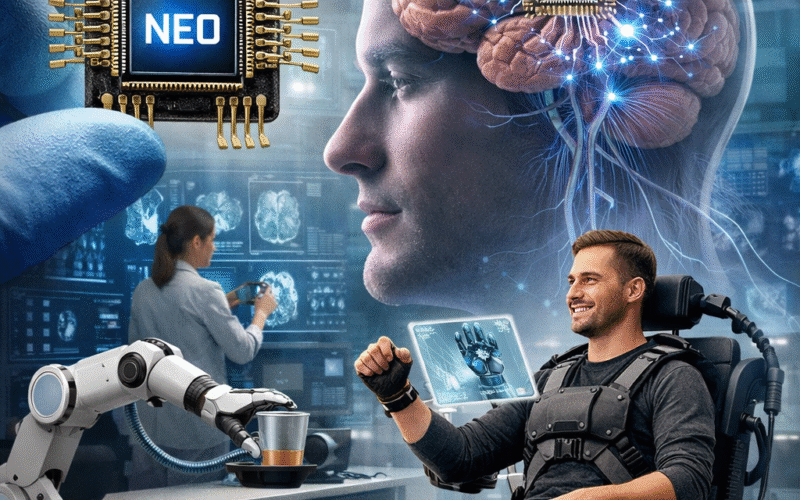
China Beats Neuralink to Market: The “NEO” Brain Chip Revolutionizes Paralysis Treatment
In a landmark move for medical technology, China has officially approved the world’s first commercially available brain-computer interface (BCI) for clinical use. The device, known as “NEO” (Neural Electronic Opportunity), developed by a team from Tsinghua University, marks a significant leap ahead in the global race to merge human consciousness with digital signals.
Table Of Content
While Elon Musk’s Neuralink has dominated headlines with high-profile human trials, NEO has quietly secured the regulatory green light to begin transforming the lives of patients suffering from severe physical disabilities.
How the “NEO” Brain Chip Revolutionizes Paralysis Treatment Works: A Bridge for the Mind
The NEO system is specifically designed for patients with quadriplegia resulting from cervical spinal cord injuries. Unlike traditional treatments that rely on physical therapy alone, NEO bypasses the damaged nerves entirely.
-
The Implant: The chip is surgically placed beneath the skull. Unlike Neuralink’s approach, which involves ultra-fine threads penetrating the brain tissue, NEO is minimally invasive. It sits on top of the brain’s membrane (the dura mater), collecting neural signals without damaging delicate brain cells.
-
The Smart Glove: Once the chip captures the patient’s intent to move, it transmits these signals wirelessly to a wearable “Smart Glove.“
-
Restoring Function: The glove uses these signals to physically move the patient’s hand, allowing them to grip objects, hold bottles, and eat independently.
NEO vs. Neuralink: A Different Kind of Winner
While both technologies share the same goal, their philosophies differ. The NEO chip focuses on long-term stability and safety by remaining outside the brain tissue itself. This reduces the risk of inflammation or long-term scarring.
Chinese regulators have classified NEO as a “Class III” medical device—the highest safety tier—acknowledging its readiness for widespread clinical application. This commercial approval means the technology is moving out of the lab and into the hands of those who need it most.
“The NEO chip has filled a gap in both domestic and international clinical applications for invasive brain-computer interfaces.” — Clinical Report Summary
The Impact on Patients
The videos and images from the launch show a patient who was previously unable to move his limbs now successfully grasping a water bottle and bringing it to his mouth. For someone with a spinal cord injury, this “simple” task represents a massive restoration of personal dignity and autonomy.
Future Horizons
The success of NEO opens the door for further applications, including:
-
Prosthetic Control: Moving robotic limbs with the speed and fluidness of natural ones.
-
Communication: Allowing “locked-in” patients to type or speak through computers via thought.
-
Neural Repair: Potential future versions that might help bridge the spinal gap permanently.
Summary Table: NEO at a Glance
| Feature | Details |
| Device Name | NEO (Neural Electronic Opportunity) |
| Origin | Tsinghua University, China |
| Invasiveness | Minimally invasive (placed under the skull, outside the brain) |
| Target Patients | Quadriplegia / Spinal Cord Injuries |
| Key Accessory | Wireless Smart Glove for hand movement |
| Status | Approved for commercial/clinical use |
As we move into 2026, the arrival of NEO in the commercial market signals that the era of “Cybernetic Medicine” is no longer science fiction—it is a medical reality.







No Comment! Be the first one.