



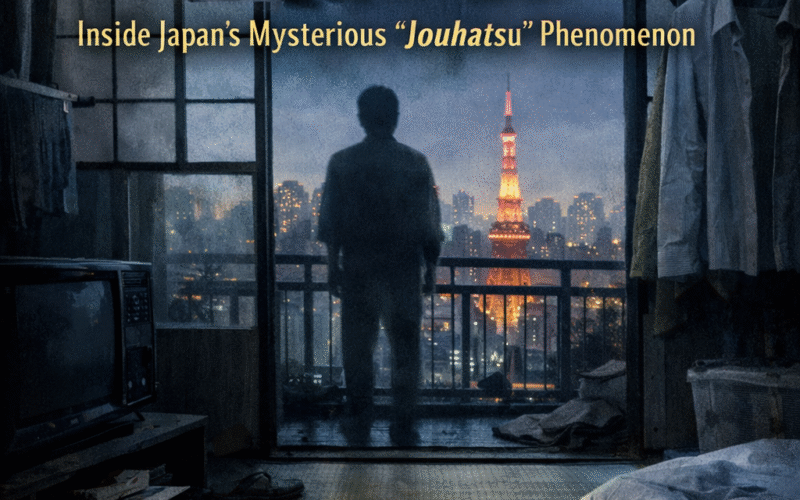
The Evaporated People: Inside Japan’s Mysterious “Jouhatsu” Phenomenon
In an age where digital footprints track nearly every movement, the idea of completely disappearing may seem impossible. Yet in Japan, thousands of people manage to do exactly that each year—legally and deliberately. This phenomenon is known as Jouhatsu (蒸発), a term that translates to “evaporation,” describing individuals who vanish from their lives without a trace.
Table Of Content
- What Is Jouhatsu?
- Why Do People Choose to Disappear?
- Financial Pressure and Debt
- Domestic Violence and Safety
- Social Shame and Cultural Expectations
- Emotional and Psychological Strain
- The Role of “Night Movers” (Yonige-ya)
- How They Operate
- A Legal Framework That Enables Disappearance
- The Aftermath: Families Left Behind
- Lack of Closure
- Financial Impact
- Endless Searches
- Life After Disappearance
- A Society Reflecting Its Pressures
- Conclusion
Far from fiction, Jouhatsu represents a deeply human response to overwhelming social, financial, and personal pressures. It is both an escape and a consequence—one that leaves behind not only old identities, but also unanswered questions and fractured families.
What Is Jouhatsu?
Jouhatsu refers to individuals who intentionally disappear from their established lives. Unlike cases involving abduction or foul play, these disappearances are voluntary. People walk away from their homes, careers, and relationships, often without informing anyone.
One day they exist within their familiar routines; the next, they are gone—leaving behind silence and uncertainty. There are no farewell notes, no forwarding addresses, and often no digital trails. For those left behind, the absence becomes a lingering mystery.
Why Do People Choose to Disappear?
The motivations behind Jouhatsu are rarely criminal. Instead, they are rooted in deeply personal struggles shaped by societal expectations and individual hardship.
Financial Pressure and Debt
Japan’s economic structure, combined with high-interest loans and social expectations of financial stability, can push individuals into overwhelming debt. For some, disappearing feels like the only way to escape mounting obligations and the stigma associated with financial failure.
Domestic Violence and Safety
For victims of abuse, especially those with limited support systems, vanishing can be a means of survival. In certain cases, disappearing offers a safer alternative than remaining in a dangerous environment.
Social Shame and Cultural Expectations
Japanese society places significant emphasis on honor, responsibility, and conformity. Experiences such as job loss, divorce, or academic failure can carry intense feelings of shame. Rather than confronting these challenges publicly, some individuals choose to remove themselves entirely.
Emotional and Psychological Strain
Toxic relationships, workplace burnout, and mental health struggles can create a sense of entrapment. Jouhatsu becomes, for some, a drastic attempt at reclaiming control and starting over.
The Role of “Night Movers” (Yonige-ya)
Disappearing is not as simple as walking away. In Japan, a specialized industry exists to facilitate these vanishing acts. Known as “Yonige-ya,” or “night movers,” these companies provide discreet relocation services for individuals seeking to disappear.
How They Operate
Secrecy:
Operations are typically conducted at night to avoid drawing attention from neighbors or family members.
Efficiency:
Teams can pack and move an entire household within hours, ensuring a swift and quiet exit.
Relocation:
Clients are often relocated to densely populated urban areas where anonymity is easier to maintain. Large cities provide the ideal environment to blend in and avoid recognition.
These services are not illegal; they operate within the boundaries of privacy laws, offering a structured pathway for those determined to leave their lives behind.
A Legal Framework That Enables Disappearance
One of the most striking aspects of Jouhatsu is its legality. Japan’s strict privacy laws prioritize individual autonomy, even in cases of disappearance.
If there is no evidence of a crime or immediate danger, authorities generally do not intervene. Police are not permitted to disclose a person’s whereabouts to family members if that individual has chosen to leave voluntarily.
This legal stance reflects a broader cultural respect for personal privacy. However, it also creates a system in which people can effectively erase themselves without legal consequences.
The Aftermath: Families Left Behind
While Jouhatsu offers an escape for those who leave, it often creates profound suffering for those who remain.
Lack of Closure
Families are left in a state of uncertainty, unsure whether their loved one is safe, alive, or gone forever. This ambiguity can be emotionally devastating.
Financial Impact
If the missing individual was a primary earner, their sudden absence can lead to financial instability or even poverty.
Endless Searches
With limited assistance from authorities, families often turn to private investigators. These efforts can be costly and rarely guarantee answers, prolonging both hope and despair.
The emotional toll is enduring, as loved ones grapple with unanswered questions and unresolved grief.
Life After Disappearance
For those who successfully vanish, life does not necessarily become easier. Instead, it transforms into a quieter, often more precarious existence.
Many Jouhatsu individuals find work in cash-based or informal sectors, avoiding situations that require identification or official records. Day labor districts and temporary jobs provide a means of survival without drawing attention.
This lifestyle allows anonymity, but it also comes with limitations—restricted access to stable employment, healthcare, and social support. In essence, they become invisible participants in a highly structured society.
A Society Reflecting Its Pressures
The existence of Jouhatsu reveals deeper truths about the pressures embedded within modern life. It highlights the consequences of rigid social expectations, economic strain, and limited avenues for personal recovery.
For some, disappearing is not about escape alone—it is about the absence of alternatives. It is a response to systems that can feel unforgiving, where failure is difficult to reconcile publicly.
Conclusion
Jouhatsu is a complex and somber phenomenon that sits at the intersection of personal choice and societal pressure. It offers individuals a way to start over, free from past burdens, but at a significant cost.
Behind every disappearance is a story of struggle, and behind every vanished person is a network of loved ones left searching for answers. While the practice may provide relief for some, it also leaves a lasting imprint of uncertainty and loss.
In a world that increasingly records and remembers everything, the existence of Jouhatsu serves as a reminder that, for some, the desire to disappear remains stronger than the systems designed to keep us visible.







No Comment! Be the first one.