



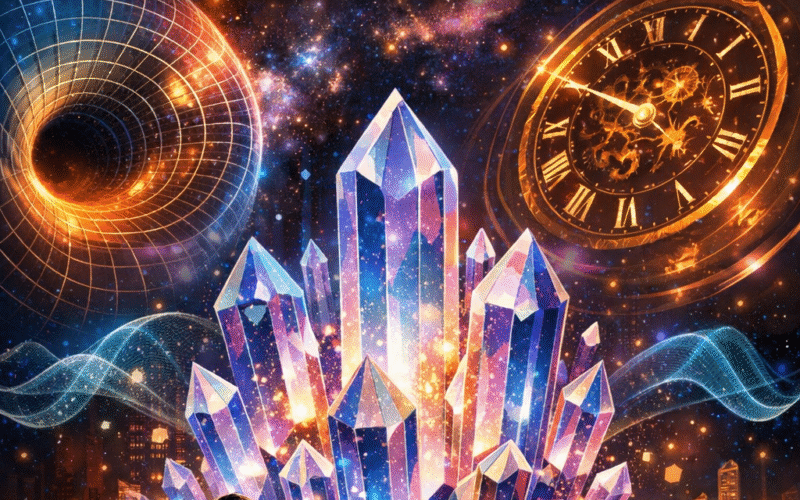
Beyond the Third Dimension: Understanding the Mystery of Time Crystals
What if matter could move forever without ever getting tired or using fuel? It sounds like science fiction, but modern physics has uncovered a phenomenon that challenges everything we thought we knew about motion and energy. This strange and fascinating discovery is known as time crystals.
Table Of Content
Unlike anything found in everyday experience, time crystals exist in a realm where the rules of classical physics no longer apply. They belong to the strange and counterintuitive world of quantum mechanics, where particles can behave in ways that seem impossible. In this article, we will explore what time crystals are, how they work, and why they could play a critical role in the future of technology.
What Are Time Crystals?
To understand time crystals, it helps to first think about ordinary crystals. Materials like salt, sugar, or diamonds are made up of atoms arranged in a repeating pattern in space. This repeating structure is what gives crystals their shape and symmetry.
Time crystals, however, take this idea a step further.
Instead of repeating in space, they repeat in time.
This means that their internal structure changes or oscillates in a regular, repeating pattern over time, even without any external input. In simple terms, a time crystal is a system that keeps moving in a predictable way forever, without needing energy.
This concept may sound impossible because it appears to violate one of the most fundamental principles of physics: that motion requires energy. However, time crystals exist under special quantum conditions that allow them to behave differently.
A New State of Matter
Time crystals are not solids, liquids, or gases. They represent an entirely new phase of matter.
In traditional physics, matter eventually settles into a state of equilibrium, where everything becomes stable and motion stops unless energy is added. Time crystals break this rule. They exist in a state where motion continues indefinitely, even at the lowest possible energy level, known as the ground state.
This unusual behavior is what makes time crystals so important. They demonstrate that there are still undiscovered states of matter waiting to be explored, and they expand our understanding of how the universe operates at its most fundamental level.
Breaking Time Symmetry
One of the key ideas behind time crystals is something called time-translation symmetry.
In physics, symmetry refers to a property that remains unchanged under certain transformations. For example, the laws of physics are generally the same whether something happens now or ten seconds later. This consistency is known as time-translation symmetry.
Time crystals break this symmetry.
Instead of remaining constant over time, they change in a repeating pattern. This means the system behaves differently at different moments, even though no external force is acting on it.
A helpful analogy is a snowflake. When water freezes into a snowflake, it breaks the symmetry of empty space by forming a structured pattern. Similarly, a time crystal breaks the symmetry of time by forming a repeating pattern of motion.
Constant Motion Without Energy
Perhaps the most fascinating aspect of time crystals is their ability to move without consuming energy.
In everyday life, motion always requires energy. A spinning wheel eventually slows down due to friction. A swinging pendulum stops unless it is pushed again. Even atoms in a material eventually settle into a stable arrangement.
Time crystals defy this expectation.
They continue to oscillate or “flip” between states indefinitely, without losing energy. This happens because they exist in a protected quantum state that prevents them from reaching equilibrium in the usual way.
To visualize this, imagine a bowl of jelly. If you poke it, it jiggles for a while and then stops. Now imagine a jelly that continues to jiggle forever, even though you never touched it. That is similar to how a time crystal behaves.
The Role of Quantum Mechanics
Time crystals are deeply rooted in quantum mechanics, the branch of physics that studies the behavior of particles at the smallest scales.
In the quantum world, particles do not follow the same rules as objects in everyday life. They can exist in multiple states at once, become entangled with each other, and exhibit wave-like properties.
Time crystals rely on these quantum effects to maintain their continuous motion. Specifically, they often exist in systems that are isolated from their environment and driven in a controlled way, allowing them to avoid energy loss.
The idea of time crystals was first proposed in 2012 by physicist Frank Wilczek. At the time, it was purely theoretical and sparked significant debate in the scientific community. Many researchers questioned whether such a system could exist without violating the laws of physics.
However, in 2016, scientists successfully created experimental versions of time crystals in laboratory settings using quantum systems such as trapped ions and spin systems. These experiments confirmed that time crystals are not just theoretical curiosities, but real physical phenomena.
How Time Crystals Work (Simplified)
Understanding the detailed physics behind time crystals can be complex, but the core ideas can be explained in simple terms:
- Breaking Symmetry: Time crystals disrupt the normal symmetry of time by repeating their behavior in a fixed cycle.
- Persistent Oscillation: They continuously switch between states without slowing down or requiring additional energy.
- Quantum Stability: Their motion is protected by quantum effects, which prevent energy loss and maintain their structure.
- Non-Equilibrium State: Unlike most systems, they do not settle into a static equilibrium, allowing motion to persist indefinitely.
Why Do Time Crystals Matter?
Time crystals are not just a scientific curiosity. They could have important practical applications, especially in the field of advanced technology.
Quantum Computing
One of the most promising applications of time crystals is in quantum computing.
Quantum computers rely on delicate quantum states that are easily disrupted by external noise. Time crystals, with their stable and repeating behavior, could serve as reliable components for storing and processing information.
Their resistance to energy loss and environmental disturbances makes them ideal candidates for building more robust quantum systems.
Precision Measurement
Time crystals could also be used in highly accurate clocks and sensors. Their consistent oscillation could provide a new way to measure time with extreme precision, potentially surpassing existing technologies.
Fundamental Physics Research
Beyond practical applications, time crystals help scientists explore the limits of physical laws. They challenge traditional ideas about equilibrium, energy, and motion, opening new avenues for research and discovery.
Conclusion
Time crystals are a powerful reminder that the universe still holds many mysteries. What once seemed impossible is now a reality, thanks to advances in quantum physics and experimental technology.
As scientists continue to study and refine these systems, we may discover even more surprising behaviors that reshape our understanding of nature. Whether you are a science enthusiast or simply curious about the future, time crystals offer a glimpse into a world where the rules are still being written.





No Comment! Be the first one.