



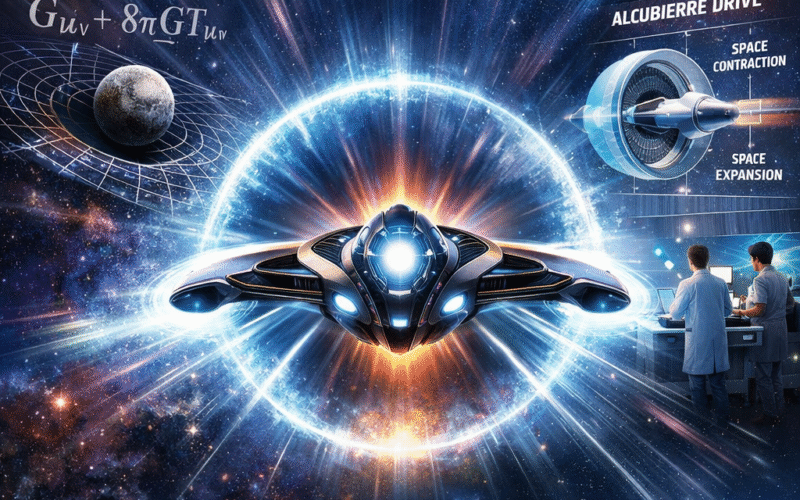
Beyond the Speed of Light: Can We Actually Build a Warp Drive?
For over a century, modern physics has drawn a hard boundary around how fast anything in the universe can travel. According to Einstein’s Theory of Relativity, nothing with mass can move faster than the speed of light—about 300,000 kilometers per second. While that sounds incredibly fast, the vast distances between stars make interstellar travel a daunting challenge. Even reaching our nearest stellar neighbor would take years, if not decades, using current or near-future propulsion technologies.
Table Of Content
But what if there were a loophole? What if we didn’t have to move through space faster than light—but could instead move space itself?
The Warp Drive Concept: Moving Space, Not the Ship
In 1994, physicist Miguel Alcubierre proposed a bold theoretical solution now known as the Alcubierre Drive. His idea didn’t break the laws of physics—it worked around them.
Instead of accelerating a spacecraft through space, the concept involves placing it inside a “warp bubble.” Within this bubble, the spacecraft remains stationary relative to its local space. The motion comes from manipulating spacetime itself:
- In front of the bubble: Space is compressed (contracted).
- Behind the bubble: Space is expanded.
This creates a wave-like effect where space carries the bubble—and the spacecraft within it—forward. A helpful analogy is an airport moving walkway: you can stand still, yet still move forward because the surface beneath you is in motion.
Because the spacecraft itself isn’t accelerating in the traditional sense, passengers inside wouldn’t feel extreme forces. In theory, the ship could reach speeds faster than light relative to distant observers without violating relativity.
What About Time Dilation?
One of the strangest consequences of traveling near the speed of light is time dilation. As velocity increases, time slows down for the traveler relative to those who remain stationary. This leads to the famous “twin paradox,” where one twin traveling at high speed ages more slowly than the one who stays on Earth.
Warp drive concepts appear to sidestep this issue. Since the spacecraft isn’t moving through space in the usual way—but is instead carried by a distortion of spacetime—time inside the bubble could remain synchronized with time outside it. In other words, travelers might not experience the extreme temporal effects associated with near-light-speed journeys.
However, it’s important to note that this aspect is still theoretical and not fully understood. The interaction between warp bubbles and time remains an open question in physics.
The Exotic Energy Problem
For many years, the biggest obstacle to warp drive technology wasn’t the concept—it was the fuel.
Alcubierre’s original equations required something called negative energy or exotic matter. This hypothetical substance would have properties opposite to normal matter, including negative mass. While tiny quantum effects resembling negative energy have been observed (such as in the Casimir effect), no known method exists to produce or control it in the enormous quantities required for a warp drive.
Because of this, the idea was largely dismissed as a mathematical curiosity—interesting, but impractical.
A Shift in Perspective: The 2021 Developments
In 2021, a new wave of research offered a surprising twist. Scientists proposed that warp-like solutions might not require negative energy after all. By carefully redesigning the geometry of the warp bubble and the distribution of mass, it may be possible to achieve similar effects using only positive energy—ordinary matter and gravity.
This doesn’t mean warp drives are suddenly within reach. But it does move the concept from “physically impossible” to “theoretically plausible,” which is a significant step forward.
The Real Challenge: Energy on a Planetary Scale
Even with this breakthrough, the biggest hurdle remains: energy.
To create a warp bubble large enough to hold a spacecraft, calculations suggest that we would need an immense amount of energy—potentially equivalent to the mass-energy of an entire planet, such as Jupiter. That’s far beyond anything humanity can currently produce, store, or control.
To put it in perspective:
- The total energy consumption of human civilization is negligible compared to what a warp drive would require.
- We would need entirely new technologies for energy generation, storage, and manipulation—likely involving breakthroughs in fields we don’t yet fully understand.
In short, while the math may allow warp drives, engineering them is another matter entirely.
Additional Challenges
Beyond energy requirements, several other unresolved issues remain:
- Stability of the warp bubble: Can it be created and maintained without collapsing?
- Control and navigation: How do you steer a warp bubble once it’s formed?
- Causality concerns: Faster-than-light travel raises the possibility of time paradoxes, which could conflict with fundamental physics.
- Interaction with surrounding space: What happens when the bubble encounters matter or radiation along its path?
Each of these questions represents a major scientific and engineering challenge.
From Science Fiction to Scientific Possibility?
Warp drives have long been a staple of science fiction, offering a way to explore distant galaxies within a human lifetime. Today, they remain firmly in the realm of theory—but no longer purely fantasy.
The key shift is this: physicists are no longer asking if the laws of nature allow warp travel, but how it might be achieved within those laws.
That distinction matters.
While practical warp drives may still be centuries away—if they are possible at all—the idea has evolved from an impossible dream into a legitimate area of scientific inquiry.
Final Thoughts
The universe is vast beyond imagination, and the speed of light sets a daunting limit on exploration. But concepts like the Alcubierre Drive remind us that physics is not just a set of constraints—it’s also a framework full of surprising possibilities.
For now, warp drives remain theoretical. We lack the energy, the technology, and perhaps even the full understanding required to build one. But the door is no longer closed.
And in science, even a slightly open door can change everything.







No Comment! Be the first one.