



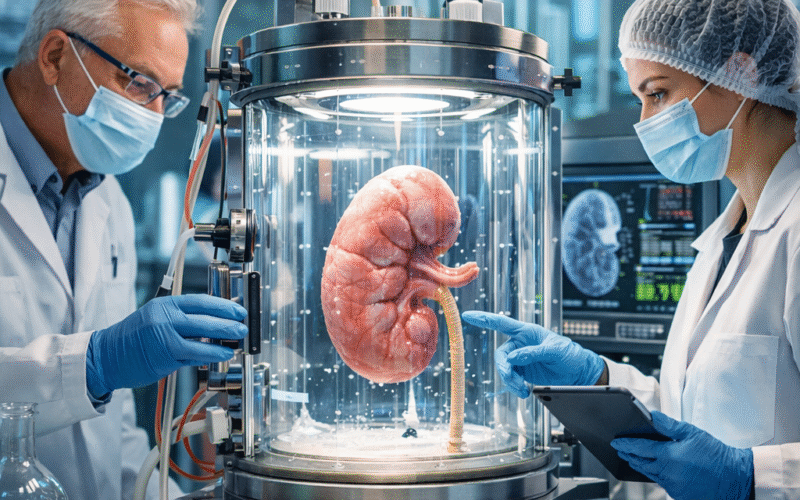
The Future of Medicine: Scientists Grow Functional Human Kidneys in the Lab
For decades, the idea of growing replacement organs in a laboratory sounded like science fiction. Patients suffering from organ failure had only two options: wait for a donor transplant or rely on long-term treatments like dialysis. Today, that reality is beginning to change.
Table Of Content
- What Is a Bioengineered Kidney?
- How the Process Works
- 1. The Scaffold
- 2. Cell Seeding
- 3. The Bioreactor
- 4. Functional Testing
- Why This Breakthrough Matters
- Addressing Organ Shortages
- Reduced Risk of Rejection
- A Permanent Alternative to Dialysis
- Lab-Grown Kidneys vs. Traditional Transplants
- Key Benefits of Bioengineered Organs
- 1. Personalized Medicine
- 2. Scalability
- 3. Medical Innovation
- Current Challenges
- Complexity of the Kidney
- Longevity and Durability
- Scaling for Human Use
- Regulatory and Clinical Trials
- The Future of Regenerative Medicine
- Conclusion
Recent breakthroughs in bioengineering have brought us closer than ever to a future where fully functional human kidneys can be grown in the lab. Even more remarkably, these kidneys are capable of performing essential tasks such as filtering blood and producing urine—just like natural organs.
This development represents a major leap forward in regenerative medicine and offers new hope for millions of people worldwide.
What Is a Bioengineered Kidney?
A bioengineered kidney is an artificial organ created using a patient’s own cells. Unlike traditional transplants, which depend on donor availability, this method uses advanced biological techniques to build a functioning organ from scratch.
The process relies on two key steps:
- Decellularization: Removing all living cells from an existing kidney, leaving behind a structural framework (scaffold).
- Re-seeding: Repopulating that scaffold with new, healthy cells derived from the patient.
The result is a personalized organ that closely mimics the structure and function of a natural kidney.
How the Process Works
Creating a lab-grown kidney is a complex, multi-step procedure that combines biology, engineering, and medical science.
1. The Scaffold
Scientists begin with a donor kidney (often from an animal or non-transplantable human organ). They remove all cellular material, leaving behind a collagen-based structure. This “ghost” kidney retains the original architecture, including blood vessel pathways and filtration structures.
2. Cell Seeding
Next, the scaffold is infused with specialized human cells:
- Epithelial cells: Responsible for filtering and absorption
- Endothelial cells: Line blood vessels and support circulation
3. The Bioreactor
The developing organ is placed in a bioreactor—a controlled environment that simulates the human body. This system provides nutrients, oxygen, and mechanical stimulation, allowing cells to grow, organize, and mature.
4. Functional Testing
Once developed, the kidney is tested to determine whether it can:
- Filter blood effectively
- Remove waste products
- Produce urine
Early results show promising levels of functionality, marking a major milestone in the field.
Why This Breakthrough Matters
The ability to grow functional kidneys in the lab could completely transform how we treat kidney disease and organ failure.
Addressing Organ Shortages
Traditional transplants depend on donor availability, leading to long waiting lists. Many patients wait years—and some never receive an organ.
Lab-grown kidneys could be produced on demand, eliminating the need for donor matching and drastically reducing waiting times.
Reduced Risk of Rejection
One of the biggest challenges in organ transplantation is immune rejection. Patients must take lifelong immunosuppressive drugs, which can have serious side effects.
This could reduce or even eliminate the need for immunosuppressants.
A Permanent Alternative to Dialysis
For patients with End-Stage Renal Disease (ESRD), dialysis is often the only option while waiting for a transplant. While lifesaving, dialysis is time-consuming and does not fully replicate kidney function.
Lab-grown kidneys offer the potential for a permanent, natural solution—restoring normal kidney function and improving quality of life.
Lab-Grown Kidneys vs. Traditional Transplants
| Feature | Traditional Transplant | Lab-Grown Kidney |
|---|---|---|
| Availability | Limited by donors; long waiting lists | Potentially on-demand |
| Organ Rejection | High risk; requires medication | Low risk; patient-derived cells |
| Functionality | Immediate but may decline | Designed to mimic natural function |
| Long-Term Outlook | Depends on donor match and care | Potentially more stable and personalized |
Key Benefits of Bioengineered Organs
1. Personalized Medicine
Each organ is tailored to the patient’s genetic makeup, reducing complications and improving outcomes.
2. Scalability
As technology improves, it may become possible to produce organs at scale, addressing global shortages.
3. Medical Innovation
This breakthrough opens doors to engineering other organs, including hearts, lungs, and livers.
Current Challenges
Despite the progress, there are still significant hurdles before lab-grown kidneys become widely available.
Complexity of the Kidney
The human kidney is one of the most complex organs in the body, containing over 30 different cell types and intricate filtration systems. Replicating this complexity remains a major scientific challenge.
Longevity and Durability
Scientists must ensure that bioengineered kidneys can function effectively for many years—ideally decades—inside the human body.
Scaling for Human Use
While prototypes have shown success, creating full-sized organs capable of supporting adult patients is still under development.
Regulatory and Clinical Trials
Before these kidneys can be used in hospitals, they must undergo extensive clinical testing to ensure safety and effectiveness.
The Future of Regenerative Medicine
The successful development of functional, urine-producing kidneys in the lab marks a turning point in medical science. It signals a shift from treating disease to rebuilding the human body.
In the future, hospitals may no longer rely on donor lists. Instead, patients could receive custom-grown organs created specifically for them—reducing complications and saving countless lives.
Researchers are already exploring similar approaches for other organs, bringing us closer to a world where organ failure is no longer a life-threatening condition.
Conclusion
The ability to grow human kidneys in the lab is a monumental achievement in bioengineering and regenerative medicine. While challenges remain, the progress so far is undeniable.







No Comment! Be the first one.